






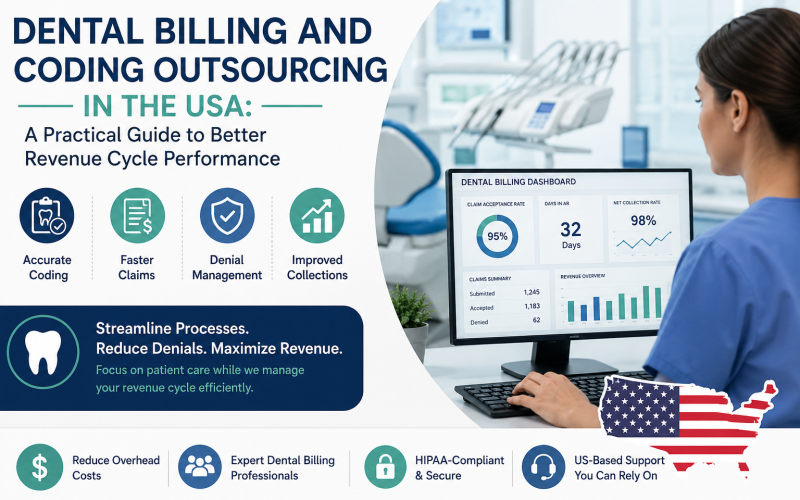
Dental practices have become increasingly complex businesses. Providing excellent patient care is still the priority, but behind every successful practice is a billing process that keeps claims moving, payments accurate, and outstanding balances under control. Even a well-run dental office can lose revenue when claims are submitted incorrectly, insurance benefits are misunderstood, or follow-ups are delayed.
This is where dental billing experts can make a meaningful difference. Their role goes beyond entering charges and sending claims. Experienced professionals understand payer requirements, dental coding, claim documentation, eligibility verification, payment posting, denial management, and accounts receivable workflows. By bringing these areas together, practices can create a more organized revenue cycle without putting additional pressure on clinical staff.
For dentists and practice managers in the USA, the right billing approach can improve financial visibility while allowing the internal team to spend more time on patients.
Why Dental Billing Has Become More Challenging
Dental billing may look straightforward from the outside, but the process involves several moving parts. Every procedure must be documented correctly, coded appropriately, submitted to the appropriate payer, and tracked until payment is received.
Insurance plans also differ in their coverage rules. A procedure that is covered under one patient’s plan may have limitations, exclusions, waiting periods, frequency restrictions, or documentation requirements under another.
Common problems include:
- Incorrect or incomplete patient information
- Eligibility not being verified before treatment
- Missing supporting documentation
- Incorrect procedure coding
- Claims submitted to the wrong payer
- Delayed claim follow-up
- Unresolved denials
- Incorrect payment posting
- Growing insurance accounts receivable
- Patient balances that are difficult to collect
When these issues happen repeatedly, even small amounts of missed revenue can accumulate.
What Dental Billing Experts Actually Do
A professional billing team typically manages several stages of the revenue cycle. The exact responsibilities depend on the practice, but the objective is usually the same: reduce avoidable billing problems and make the payment process more consistent.
Patient Eligibility and Insurance Verification
Before treatment, confirming insurance eligibility can prevent many downstream problems.
Billing professionals can review information such as:
- Active insurance status
- Deductibles
- Annual maximums
- Coverage percentages
- Waiting periods
- Frequency limitations
- Remaining benefits
- Exclusions and limitations
Accurate verification also helps the front-office team communicate expected patient responsibility more clearly.
Dental Claims Submission
Claims need accurate patient, provider, procedure, insurance, and documentation information. A small mistake can result in a rejected or denied claim.
Dental billing experts review claims before submission and monitor their progress afterward. This creates a more structured process than simply submitting claims and waiting for payment.
Denial Management
Denials are one of the most important areas of revenue-cycle management.
A denial should not simply be written off or resubmitted without understanding why it happened. The underlying reason could involve coding, eligibility, missing documentation, timely filing, coordination of benefits, or payer-specific requirements.
A systematic denial process typically involves:
- Identifying the denial reason
- Reviewing the original claim
- Checking payer requirements
- Correcting the underlying issue
- Resubmitting or appealing when appropriate
- Tracking the claim until resolution
This approach helps practices identify recurring problems rather than repeatedly treating the same symptoms.
Dental Billing Companies vs. In-House Billing
Many dental practices initially manage billing internally. For a smaller practice with a straightforward workflow, this can work well. However, billing responsibilities can become difficult to manage as patient volume increases.
Staff members may have to balance billing with scheduling, patient communication, insurance calls, treatment coordination, and administrative duties.
This is one reason practices evaluate dental billing companies.
Outsourcing does not necessarily mean giving up control. A well-structured relationship can provide the practice with reporting, claim visibility, defined workflows, and regular communication while the billing team handles day-to-day revenue-cycle tasks.
For growing practices, the decision often comes down to whether internal employees have enough time and specialized knowledge to consistently manage the entire billing process.
Choosing Among Dental Billing Companies in the USA
The number of dental billing companies in USA markets can make choosing a provider difficult. Practices should look beyond promises of faster payments or lower costs.
A better evaluation considers the company’s actual processes.
Industry Experience
Dental billing requires knowledge of dental procedures, insurance workflows, coding requirements, and payer behavior. Experience specifically within dentistry can be more valuable than general billing experience.
Transparent Reporting
Practice owners should be able to understand what is happening with their claims and receivables.
Useful reporting may include:
- Claims submitted
- Claims pending
- Claims denied
- Payments received
- Outstanding accounts receivable
- Aging reports
- Denial trends
- Patient balances
Clear reporting allows management to identify financial problems before they become serious.
Denial and AR Follow-Up
Ask how the company handles unresolved claims.
A provider should have a defined process for identifying older receivables, prioritizing high-value accounts, contacting payers, correcting claims, and documenting follow-up activity.
Security and Compliance
Billing teams handle sensitive patient and insurance information. Practices should carefully evaluate how a prospective provider protects data and manages access to patient information.
Security practices, appropriate policies, staff training, and contractual responsibilities should all be considered before outsourcing billing operations.
Understanding Dental Billing RCM
Dental billing RCM refers to the financial workflow that begins when a patient schedules or receives treatment and continues until the practice receives payment and closes the account.
It can include:
Patient registration → Eligibility verification → Treatment documentation → Coding → Claim submission → Claim tracking → Payment posting → Denial management → AR follow-up → Patient balance collection
Looking at billing as a complete cycle is important because problems at one stage can affect everything that follows.
For example, inaccurate eligibility information can create an incorrect patient estimate. That can lead to unexpected patient balances, collection difficulties, and additional administrative work.
Improving the entire workflow is often more effective than fixing only the final claim-submission stage.
The Importance of Accurate Coding
Coding plays a central role in the billing process. The procedure performed must be represented accurately in the claim, supported by appropriate documentation, and submitted according to applicable requirements.
Coding errors can create unnecessary delays or financial problems.
Professional medical coding services are commonly associated with broader healthcare revenue-cycle operations, while dental practices have their own specialized dental procedure coding requirements. Practices operating across healthcare and dental environments should ensure that the people handling coding understand the specific coding systems and payer requirements relevant to each service.
This distinction is especially important for organizations that provide both dental and medical services.
When Dental and Medical Billing Overlap
Some dental organizations operate within larger healthcare groups or provide services that interact with medical insurance. In these situations, administrative teams may deal with both dental and medical claims.
That is where broader medical billing services and medical billing and coding services may become relevant.
For example, certain services may require coordination between dental documentation and medical insurance processes depending on the patient’s circumstances and applicable coverage. Having professionals who understand the difference between dental and medical billing workflows can reduce confusion.
The key is not simply having more billing staff. It is having people with the right expertise for the claims being processed.
Credentialing and Provider Enrollment Matter Too
Revenue problems can sometimes begin before a claim is ever submitted.
Provider enrollment and credentialing help establish the administrative foundation required for participation with insurance networks. Incorrect provider information, expired credentials, or enrollment issues can create avoidable billing complications.
Professional credentialing services can support practices with tasks such as maintaining provider information, monitoring enrollment requirements, and organizing documentation.
Credentialing is therefore not just an administrative formality. It can influence whether a practice is properly positioned to receive reimbursement from participating payers.
How Better Billing Processes Improve the Patient Experience
Revenue management should not come at the expense of patient relationships.
Patients want to understand what they owe and why. Confusing statements, unexpected balances, and repeated insurance issues can create frustration.
A well-organized billing process can make communication easier by providing:
- More accurate insurance estimates
- Clear patient statements
- Faster responses to billing questions
- Better documentation of insurance activity
- Consistent follow-up
- Fewer avoidable claim problems
When billing information is accurate and easy to understand, patients are more likely to trust the practice.
A Practical Example
Consider a growing dental practice that submits hundreds of claims each month.
The practice has a capable front-office team, but employees are frequently interrupted by insurance calls and claim follow-ups. Some denied claims remain unresolved for weeks because staff members are focused on patient scheduling.
The problem is not necessarily a lack of effort. It is a lack of dedicated capacity.
After introducing a structured billing workflow, claims are reviewed before submission, denied claims are categorized by reason, older receivables receive scheduled follow-up, and management receives regular reports.
The result is a more predictable process.
This example illustrates an important point: billing performance is often influenced by workflow discipline as much as by the number of claims being submitted.
What to Look for in Dental Billing Company Services
Before selecting dental billing company services, practice owners should ask practical questions.
- Which dental specialties does the company support?
- How are claims reviewed before submission?
- How are rejected and denied claims handled?
- How frequently is AR followed up?
- What reports will the practice receive?
- How is patient information protected?
- Who will communicate with the practice?
- How are payer-specific issues documented?
- Can the workflow scale as the practice grows?
- What happens when recurring denial patterns are identified?
The answers can reveal more about a provider’s capabilities than a sales presentation.
Why Specialized Dental Billing Providers Can Be Valuable
Not every billing provider offers the same level of specialization. Dental billing providers familiar with the industry’s workflows can identify issues that a general administrative team may overlook.
The value often comes from consistency.
A specialized team can establish repeatable processes for eligibility, claims, payment posting, denials, AR, and reporting. Over time, those processes can make financial performance easier to monitor.
For larger organizations, combining dental expertise with broader revenue cycle management services can also provide a more complete administrative structure across multiple healthcare operations.
How 247 Medical Billing Services Fits Into the Bigger Picture
Healthcare organizations increasingly look for billing partners that can support more than individual administrative tasks. 247 Medical Billing Services provides a broader healthcare billing perspective that includes medical billing services, medical coding services, medical billing and coding services, revenue cycle management services, and credentialing services.
For organizations managing both dental-related and medical billing operations, this broader understanding can be useful when different reimbursement workflows overlap.
The most important consideration, however, should always be whether a provider’s processes, expertise, communication, and reporting align with the practice’s actual needs.
Final Thoughts
Dental billing is no longer simply a back-office task. It is an important part of a practice’s financial health and day-to-day operations.
The right dental billing experts can help practices create stronger workflows around eligibility, claims, coding, denials, payment posting, and accounts receivable. Instead of treating each billing issue as an isolated problem, they can look at the entire revenue cycle and identify where inefficiencies begin.
Whether a practice works with an internal team or evaluates dental billing companies, the goal should remain the same: accurate claims, organized follow-up, transparent reporting, and a smoother experience for both staff and patients.
For practices considering outsourcing, the best provider is not necessarily the one making the biggest promises. It is the one that understands the practice’s workflow, communicates clearly, follows consistent processes, and treats revenue-cycle management as an ongoing operational responsibility.
Frequently Asked Questions
1. What do dental billing experts specialize in?
Dental billing experts typically work with insurance verification, dental claim submission, payment posting, denial management, accounts receivable follow-up, and other revenue-cycle processes. Their exact responsibilities depend on the practice and its billing arrangement.
2. Why do dental practices use dental billing companies?
Practices may use dental billing companies when internal staff lack the time, resources, or specialized expertise needed to manage billing consistently. Outsourcing can provide dedicated billing support while allowing practice employees to focus more heavily on patient-facing responsibilities.
3. What should I look for in dental billing providers?
Look for dental industry experience, transparent reporting, a clear denial-management process, consistent AR follow-up, strong communication, appropriate data-security practices, and workflows that can scale with the practice.
4. What is dental billing RCM?
Dental billing RCM, or revenue cycle management, covers the financial process from patient registration and insurance verification through claim submission, payment posting, denial resolution, AR follow-up, and final account resolution.
5. Can medical billing services support organizations that also provide dental care?
They can, particularly when an organization handles both medical and dental operations. However, the billing team should understand the differences between dental and medical coding, claims, payer requirements, and reimbursement workflows.
6. How can credentialing services affect revenue?
Credentialing services can help maintain accurate provider enrollment and participation information. When credentialing or enrollment information is incomplete or outdated, it can contribute to reimbursement and claim-processing problems.