




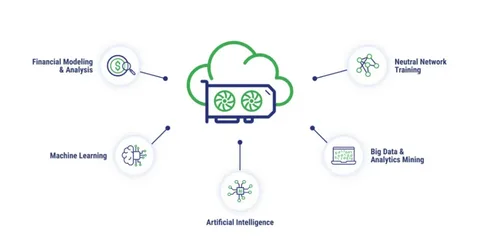
The world of computing is changing rapidly. Today, workloads like artificial intelligence, machine learning, scientific simulations, and 3D rendering demand far more processing power than traditional systems can handle.
Conventional CPU-based systems often struggle with these heavy, parallel workloads. This is where GPU as a Service (GPUaaS) steps in as a powerful solution.
Instead of buying expensive hardware, users can access high-performance GPUs through the cloud. This makes advanced computing more accessible, flexible, and cost-efficient for businesses of all sizes. With GPUaaS, organizations no longer need to invest heavily in infrastructure. Instead, they can focus on innovation while renting computing power on demand.
What Is GPU as a Service (GPUaaS)?
GPU as a Service is a cloud-based model that provides access to powerful Graphics Processing Units (GPUs) over the internet.
These GPUs are designed for parallel processing, meaning they can handle thousands of tasks at the same time. This makes them ideal for data-heavy applications like AI training, video rendering, and simulations.
Unlike traditional setups, users do not need to purchase or maintain physical hardware. Instead, they simply rent GPU resources and pay based on usage. This approach shifts computing costs from capital expenditure (CapEx) to operational expenditure (OpEx), making high-performance computing more affordable and scalable.
Why GPUs Are Essential for Modern Computing
GPUs are fundamentally different from CPUs. While CPUs process tasks one after another, GPUs process many tasks simultaneously.
This makes them extremely efficient for:
- Matrix calculations
- Deep learning operations
- Image and video processing
- Scientific modeling
In fact, GPUs can be 10x to 100x faster than CPUs for AI-related workloads. As a result, they have become the backbone of modern computing systems. GPUaaS takes this power and delivers it through the cloud, making it accessible anywhere in the world.
Why Choose GPU as a Service Over On-Premises Systems?
Building an in-house GPU infrastructure is expensive and complex. It requires not only powerful hardware but also cooling systems, energy supply, and continuous maintenance.
GPU as a Service removes these challenges completely.
1. Easy Scalability
With GPUaaS, businesses can scale resources up or down instantly. They can launch hundreds of GPUs for training large models and scale down when demand decreases.
2. No Maintenance Burden
Cloud providers handle everything—hardware upgrades, system monitoring, security patches, and performance optimization. This allows teams to focus entirely on development and innovation.
3. Global Accessibility
GPU resources can be accessed from anywhere in the world. This helps companies deploy workloads closer to users and comply with data regulations in different regions.
4. Cost Efficiency
Instead of investing millions in infrastructure, companies pay only for what they use. This makes GPU computing accessible even for startups and research teams.
Key Applications of GPU as a Service
GPUaaS is transforming multiple industries by accelerating complex workloads.
AI and Machine Learning
GPUaaS significantly reduces training time for deep learning models. Frameworks like TensorFlow and PyTorch run efficiently on cloud GPUs, allowing faster experimentation and deployment.
Scientific Research
Researchers use GPUs to simulate climate models, molecular structures, and physics experiments. These tasks require massive parallel processing, which GPUs handle effectively.
Video Rendering and Media Production
Film studios and content creators use GPUaaS to render high-resolution videos and special effects. Tasks that once took days can now be completed in hours.
Healthcare and Genomics
In healthcare, GPUs help analyze large genomic datasets. This accelerates drug discovery, disease prediction, and personalized treatment research.
Finance and Trading
Financial institutions use GPU computing for risk modeling, fraud detection, and real-time trading analytics.
How GPU as a Service Works
Using GPUaaS is simple and user-friendly. Most cloud platforms follow a similar process:
Step 1: Choose a GPU Instance
Users select a GPU type based on workload requirements. Options range from entry-level GPUs to high-performance models designed for AI training.
Step 2: Set Up the Environment
Users install required tools like CUDA, cuDNN, or pre-configured container images for faster deployment.
Step 3: Upload Data and Run Workloads
Data is uploaded to cloud storage, and workloads are executed using tools like Kubernetes or Jupyter notebooks.
Step 4: Monitor Performance
Dashboards help track GPU usage, performance, and cost. Users can optimize resources in real time.
Step 5: Scale as Needed
Resources can be increased or reduced instantly depending on workload demand.
Security and Reliability in GPUaaS
Cloud GPU providers prioritize security and reliability. They use encrypted data transfers, virtual private clouds, and strict isolation between users. This ensures that sensitive data remains protected while maintaining consistent performance.
Compliance with standards like GDPR and HIPAA makes GPUaaS suitable for industries like healthcare and finance.
The Future of GPU as a Service
The demand for GPU computing is expected to grow rapidly as AI models become more advanced and data-heavy.
Future GPUaaS platforms will focus on:
- Faster and more energy-efficient GPUs
- Advanced AI optimization features
- Edge computing integration
- Hybrid cloud models
- Improved cooling and sustainability
As models grow into billions or even trillions of parameters, GPUaaS will play a central role in supporting next-generation innovation.
Conclusion
GPU as a Service is changing how organizations approach high-performance computing. It removes the need for expensive infrastructure and replaces it with flexible, scalable cloud solutions. By offering on-demand access to powerful GPUs, it enables faster AI development, smoother simulations, and efficient data processing across industries.
Whether for startups, researchers, or large enterprises, GPUaaS provides a practical way to unlock advanced computing without technical or financial barriers.