




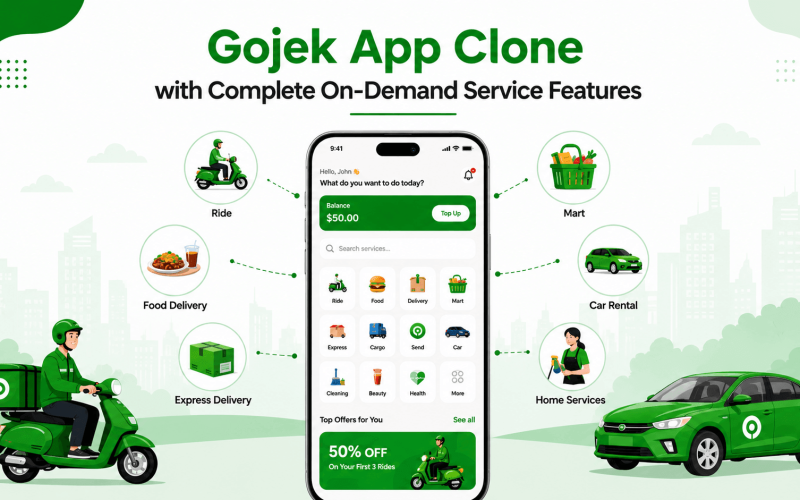
The digital revolution has fundamentally shifted how we live. In our current high-speed era, “convenience” isn’t just a luxury; it’s the primary currency. Leading this charge is the Gojek app, a pioneer from Indonesia that redefined the “Super App” category. By offering a unified platform for transportation, food delivery, and professional services, Gojek has become an indispensable part of daily life for millions.
For entrepreneurs, the success of this model has created a massive opportunity. Creating a Gojek app clone allows you to replicate a proven, profitable framework while tailoring it to your local market. This article provides an in-depth exploration of the critical components required to build, launch, and scale a multi-service on-demand platform.
Understanding the “Super App” Phenomenon
The Swiss Army Knife of Digital Services
At its core, Gojek is the ultimate digital multi-tool. It doesn’t just do one thing well; it does everything. From ride-hailing and grocery shopping to on-demand massage therapy and house cleaning, it addresses the “pain points” of urban living. When you build a clone, you aren’t just making a copy; you are adopting a business philosophy that prioritizes the user’s time above all else.
Why the Clone Model Works
Think of the clone model as a high-performance blueprint. You aren’t reinventing the wheel; you are using a wheel that has with a “remix” that hits all the right notes while adding your own unique flair.
A Rocketing Market Demand
The appetite for on-demand services is expanding at an astronomical rate. Consumers have developed a “one-click” expectation for every facet of their lives. Whether it’s a midnight snack or a ride to the airport, people want it now. Launching a Gojek clone positions you at the center of this booming economy, where instant gratification is the baseline for success.
Core Features Every Gojek Clone Needs
To survive in a competitive landscape, your platform must be robust, intuitive, and feature-rich.
| Feature Category | Description |
| Unified User Interface | A clean, “thumb-friendly” design that lets users switch between services without friction. |
| Multi-Service Catalog | Integration of rides, logistics, food, and home services under a single login. |
| Live Tracking & GPS | Real-time map updates so users can track their driver or delivery partner with precision. |
| Smart Notifications | Automated pushes to keep users informed about order status, discounts, and arrivals. |
| Secure Payment Suite | Integration with credit cards, digital wallets, and “pay on delivery” options. |
Why a Clone is Your Best Business Move
1. Remarkable Cost-Efficiency
Building a multi-service platform from total scratch is like building
a skyscraper without a plan—it is prohibitively expensive. A Gojek clone acts as a budget-friendly alternative. It provides a feature-loaded platform at a fraction of the cost, allowing you to spend your capital on what really matters: marketing and service provider acquisition.
2. Rapid Time-to-Market
In the tech world, speed is life. Using a pre-built framework means you can launch in weeks rather than years. While your competitors are still debating their app’s color palette, your platform could already be live, processing orders and generating revenue.
3. Total Customization
A clone is a foundation, not a prison. You have the flexibility to pivot your strategy as you learn more about your users. Want to focus purely on eco-friendly delivery? Or perhaps niche medical services? The modular nature of a clone allows you to “dance” with the market trends, adjusting your features in real-time.
The Technical Backbone: Building for Scale
The Front-End: Making it Shine
The user interface (UI) is your digital storefront. It must be aesthetically pleasing and incredibly responsive. Using modern frameworks like React Native or Flutter ensures your app feels smooth on both iOS and Android. If the front-end lags, your users will leave. It’s that simple.
The Back-End: The Silent Engine
Behind the scenes, you need a powerhouse. Scalable cloud solutions like AWS (Amazon Web Services) or Google Cloud act as the digital vault for your data. A robust back-end ensures that even when thousands of users are ordering at once, your system stays upright and efficient.
API Power-Ups
Think of APIs as the “secret sauce.” By integrating third-party services for mapping (Google Maps), payments (Stripe/Braintree), and communication (Twilio), you add high-level functionality without having to build these complex systems yourself.
How to Turn Your App into a Revenue Machine
Building the app is only half the battle; you also need a sustainable way to make money.
-
Commission-Based Revenue: This is the industry standard. You take a percentage (typically 10-25%) of every transaction facilitated through the app. It aligns your success directly with the success of your service providers.
-
Tiered Subscription Plans: Offer a “Premium” tier for users. For a monthly fee, they could get free deliveries, lower service fees, or priority booking. This creates a predictable, recurring cash flow.
-
Targeted In-App Advertising: Local businesses will pay to be at the top of your search results. As long as the ads are relevant and non-intrusive, this is a powerful “passive” income stream.
-
Strategic Partnerships: Collaborate with big brands for exclusive launches. For example, a partnership with a major grocery chain can drive massive traffic to your delivery vertical.
Navigating the Roadmap to Launch
The Future: What’s Next for On-Demand?
The on-demand landscape is shifting from “convenient” to “anticipatory.” In the near future, AI will predict what you want before you even open the app. We will see integrations with Smart Home systems—where your fridge tells your app to order milk automatically—and the rise of autonomous delivery drones.
Those who invest in a Gojek clone today aren’t just building an app for 2026; they are securing a place in the future of the digital economy.