



External wall insulation systems can significantly improve a building’s thermal efficiency and weather resistance. Celotex insulation boards are often incorporated into these systems to deliver high-performance thermal protection while supporting various external finishes. Successful installation requires careful attention to specification, fixing methods, and compatibility with other system components. Understanding how Celotex functions within external wall insulation systems helps ensure reliable performance, durability, and long-term energy savings.
External Wall Insulation: Context and Demand
Demand for external wall insulation (EWI) has grown substantially across the UK in recent years, driven by rising energy costs, tightening building regulations, and the widespread ambition to improve the thermal performance of the existing housing stock. Unlike cavity fill insulation, EWI applies to virtually any wall construction type — solid brick, stone, concrete, or timber frame — making it a genuinely universal solution for properties that have exhausted other insulation options.
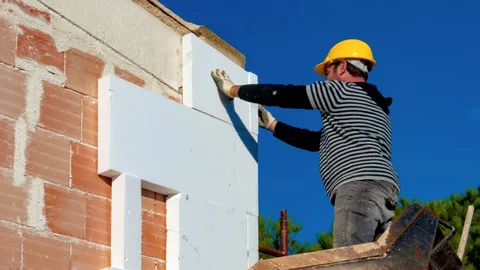
The system involves bonding and mechanically fixing a continuous insulation layer to the external wall face, followed by a reinforced render system or other cladding finish. Correctly installed, it eliminates cold bridging at floor junctions, maintains the thermal mass of the wall within the insulated envelope, and can transform the appearance of a property while significantly reducing its heating demand.
Why PIR Boards Work Well in EWI Systems
Traditional EWI systems use expanded polystyrene (EPS) as the primary insulation layer. EPS is light, easy to cut, and available in large sheet sizes, making it convenient on site. For most applications, it provides adequate thermal performance in board thicknesses of 80–150 mm. Where wall offsets from boundaries, planning height restrictions, or architectural preferences limit the total build-up thickness available, however, EPS’s relatively high lambda value may make it impossible to achieve a target U-value within the available depth.
PIR boards address this directly. With approximately half the lambda value of EPS, they achieve equivalent thermal resistance at roughly half the board thickness, making them the natural choice for constrained applications.
Celotex Insulation in External Systems
When Celotex insulation boards are used in an external wall insulation context, they are installed with the foil facing on the warm side — inward — to maximize the radiant barrier contribution within the construction. The boards are mechanically fixed with EWI-specific disc fixings in addition to adhesive bonding, ensuring wind load resistance is maintained independently of the adhesive bond. Fixing patterns and distances are specified by the EWI system supplier based on the exposure zone and wall substrate.
Unlike EPS systems where the render base coat can be applied directly to the insulation board, PIR-based EWI systems require a specific primer coat on the PIR surface before the render base is applied — the smooth foil facing of a PIR board does not provide adequate mechanical key for render without surface preparation.
External Wall Insulation: Full System Approach
The performance and longevity of an external wall insulation system depends on every element being correctly specified and installed — not just the insulation board. The substrate preparation (repairing defective mortar joints, treating any biological growth, and ensuring adequate adhesive bond strength) sets the foundation. The render base coat, reinforcing mesh, and topcoat must be from a declared compatible system, since interactions between products from different manufacturers can cause delamination, cracking, or color instability.
Movement joints are a particularly important detail that is sometimes overlooked in smaller domestic projects. EWI systems move slightly with temperature and moisture cycling. Without movement joints at specified intervals (typically at every floor level and at all changes of substrate), the accumulated strain concentrates at random positions and causes cracking. A correctly designed joint pattern is invisible in the finished facade but prevents a type of failure that is both unsightly and expensive to repair.
Cost and Programme Considerations
EWI projects require scaffolding for anything above ground floor level, which represents a significant fixed cost that makes the system most cost-effective when the whole property is treated in one mobilization.
Programme duration for a standard two-storey semi-detached property is typically two to three weeks for a straightforward system, longer for properties with complex geometry, significant substrate repair, or heritage considerations.
Moisture Management and Ventilation Considerations
Effective moisture control is essential for the long-term success of any external wall insulation system. Before installation, walls should be inspected for rising damp, penetrating moisture, or structural defects, as these issues must be resolved to prevent future damage. While Celotex PIR boards offer excellent thermal performance, the overall wall design should also allow appropriate moisture management through compatible renders, sealants, and detailing around windows, doors, and roof junctions. Proper ventilation within the property remains equally important, helping to reduce condensation risk, improve indoor air quality, and ensure the insulation system performs efficiently throughout its service life.
Conclusion
External wall insulation with high-performance PIR boards is one of the most effective routes to dramatically improving the thermal performance of older solid-wall and hard-to-insulate properties. Insulation Point Limited supplies Celotex insulation boards and a comprehensive range of EWI system ancillaries, making it a practical single source for contractors and specifiers working on external wall projects of any scale.