




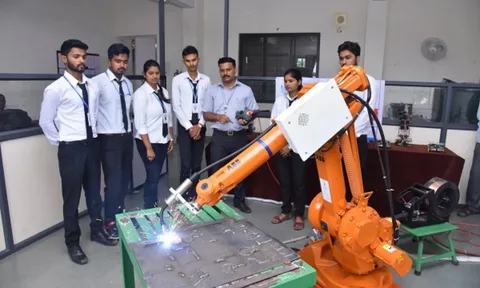
A plant in Pune had six months to increase output without adding another shift. The old answer would have been more people, more overtime, more manual checks. This time, they installed machine vision for quality inspection, added a robot at the packing line, and retrained three technicians to handle robot maintenance. Output went up. Rework dropped. Nobody lost their job, but the work changed.
That shift is happening all over the country. India’s industrial robotics market is projected to grow at a CAGR of 15.87% from 2026 to 2034, reaching 28.6 thousand units by 2034. The real story is not the machines themselves. It is the people needed to run, maintain, and improve them. A Robotics and Automation Course in India is becoming the shortest route into that workforce.
Why does this course matter now?
Factories, warehouses, and assembly lines are under pressure to do more with less. Labor is still important, but repetitive work is increasingly being handed to robots, vision systems, and automated controls. The companies adopting these systems are not only looking for operators. They want people who can troubleshoot sensors, tune PLC logic, read error logs, and keep production moving.
That is where a Robotics and Automation Course in India fits. It prepares students for the practical side of automation, not just the theory. Industry-focused programs such as Coursera’s Fundamentals of Robotics & Industrial Automation cover sensors, servo systems, interfacing, and simulation, which are the same building blocks used on shop floors. That mix matters because the work is rarely clean or predictable. A conveyor misalignment, a bad sensor reading, or a robot arm that drifts by a few millimeters can stop a line faster than most people expect.
What employers really look for?
Companies hiring in this space usually want three things: hands-on experience, basic programming fluency, and the ability to solve problems without waiting for outside support. In practice, that means familiarity with PLCs, robot programming, embedded systems, sensors, actuators, and often ROS or machine vision tools. They also want people who can work across mechanical, electrical, and software tasks without getting stuck in one lane.
A Robotics and Automation Course in India helps build that cross-functional habit. The better programs teach kinematics, control systems, microcontrollers, and industrial automation together. That combination is useful because real automation work rarely stays inside one subject. A packaging robot, for example, might need mechanical calibration, a control change, and a software update on the same day.
Which industries are hiring?
- Manufacturing, especially automotive, electronics, and heavy equipment.
- Logistics and warehousing, where automation is speeding up picking and sorting.
- Healthcare, where robotic systems support lab work and surgical workflows.
- Agriculture, where automation is being used for monitoring and precision tasks.
How does the right course build job readiness?
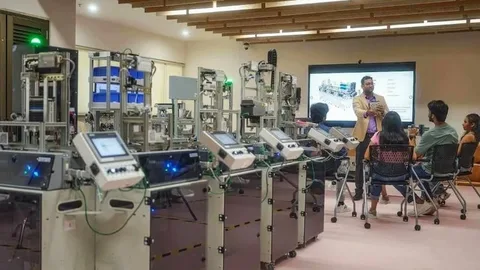
The best courses do more than explain how robots work. They make students build, test, fail, and fix. That sounds simple, but it is the part most employers care about. A student who has debugged a robot arm in a lab is far more useful than someone who has only memorized the theory.
A solid Robotics and Automation Course in India should include simulation work, lab projects, internships, and exposure to current industrial tools. IIT-linked and industry-linked programs in India increasingly include application-oriented modules, from AI in robotics to manufacturing analytics and industrial automation. Some also include hands-on exposure to machine vision, which is now common in quality control lines.
One useful sign is whether the course includes failure cases. Good training does not hide mistakes. It shows what happens when a sensor is placed badly, when a motor overheats, or when a robot picks the wrong part. That kind of practice makes a student ready for the real world, where things rarely behave like the diagram.
Why is this more than a manufacturing story?
Robotics is no longer only for large factories. It is moving into smaller plants, labs, warehouses, and service environments. That is why the skill set from a Robotics and Automation Course in India has value beyond one job title. It can lead to roles like automation engineer, robotics programmer, control systems engineer, mechatronics technician, and manufacturing engineer.
The salary range reflects that demand. Recent India-focused data shows robotics engineers and automation engineers earning strong entry and mid-career salaries, especially when they have practical project experience and internship exposure. The better the training, the better the first job conversation usually goes. Recruiters remember candidates who can explain how they solved a fault, not just what modules they studied.
What students should ask before joining?
- Does the course include lab time or only lectures?
- Will I work on real hardware or only simulation?
- Are PLCs, sensors, and machine vision part of the curriculum?
- Is there an internship or capstone project?
- Do graduates actually move into industry roles?
The workforce India is building next
India does not need more graduates who can repeat definitions. It needs people who can keep automated systems running, improve output, and adapt when the line changes. That is the quiet job of a good robotics education.
A Robotics and Automation Course in India is becoming a practical career path because it trains the exact skills companies are struggling to hire for right now. Automation is growing, but the plants still need people who understand the machines, the software, and the production pressure all at once. The students who learn that combination will not just find jobs. They will shape how India’s next wave of manufacturing actually works.