


Managing Goods and Services Tax (GST) compliance can be challenging for businesses, accountants, and tax professionals. From recording transactions and calculating taxes to reconciling invoices and filing GST returns, businesses have to manage several compliance-related tasks regularly. Handling these activities manually can consume valuable time and may also increase the risk of errors.
GST software can simplify many of these tasks by bringing important compliance activities onto a single platform. However, choosing the right software is not always easy because numerous solutions are available in the market with different features and pricing plans.
Instead of selecting software only because it is affordable, businesses should evaluate whether it offers the features required for accurate, efficient, and secure GST compliance. Here are some important features to consider before purchasing GST software.
Easy GST Return Filing
GST return filing is one of the primary reasons businesses and tax professionals use GST software. Therefore, the software should provide a simple and organised return filing process.
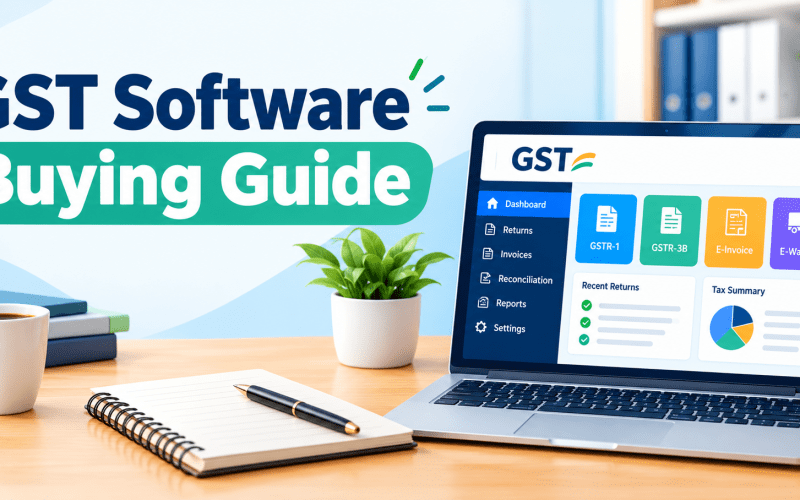
A reliable solution should support commonly required GST returns such as GSTR-1, GSTR-3B, GSTR-4, GSTR-9, and other applicable forms. It should help users prepare return data, review details, identify errors, and complete the filing process efficiently.
An easy-to-use filing interface can reduce repetitive work and make it easier for professionals managing GST compliance for multiple clients.
GST Data Reconciliation
Reconciliation is another important feature to look for when buying GST software. Businesses need to compare their purchase and sales records with the data available through the GST system to identify differences.
Effective GST software should help users identify mismatches in invoices, taxable values, GST amounts, invoice numbers, and other relevant information. A clear mismatch report can make it easier to investigate discrepancies and take corrective action before filing returns.
This feature can be particularly useful for tax professionals handling large volumes of transaction data.
Automated GST Calculations
GST calculations can become complicated when businesses deal with different products, services, tax rates, and transactions. Relying entirely on manual calculations can increase the possibility of mistakes.
GST software should automatically calculate applicable tax amounts based on transaction details. Automation can reduce manual calculations and help maintain consistency across invoices and accounting records.
Before purchasing software, users should check whether the calculation features can handle their specific business transactions and GST requirements.
E-Invoicing and E-Way Bill Support
Businesses that frequently generate invoices may benefit from GST software that supports e-invoicing and e-way bill requirements.
Having these functionalities integrated into the software can reduce the need to use multiple platforms for different compliance activities. It can also make invoice management more convenient and help businesses maintain better records.
Users should check whether the software supports the latest applicable requirements and receives timely updates when government procedures change.
Data Import and Export Options
Businesses may already maintain financial information in Excel files, accounting software, billing systems, or other applications. Therefore, GST software should provide convenient data import options.
The ability to import data can save users from entering large amounts of information manually. Similarly, export functionality allows users to download reports and transaction data for review, documentation, accounting, or other business requirements.
Flexible data management can make the transition to new GST software considerably easier.
Error Detection and Data Validation
Accuracy is an important part of GST compliance. Even a small mistake in transaction details can create problems during return preparation or reconciliation.
Good GST software should include data validation and error-detection features. These tools can identify missing information, incorrect entries, mismatched records, or other potential issues before users submit their returns.
Early identification of errors gives users an opportunity to review and correct information instead of discovering problems after filing.
Comprehensive GST Reports
Reporting features should also be considered when comparing GST software. Businesses and tax professionals may need reports to analyse sales, purchases, input tax credit, tax liabilities, invoices, and reconciliation results.
A good reporting system should present information in a clear and understandable format. Customisable or downloadable reports can be particularly useful for businesses that need to share information with management, accountants, or clients.
Secure Data Management
GST software handles sensitive financial and business information, making data security an important consideration. Before purchasing a solution, users should understand how their data is stored, protected, and backed up.
Features such as secure access, data encryption, authentication controls, and regular backups can help protect important information. Businesses should also check whether the software provider follows appropriate security practices and has reliable backup mechanisms.
Multi-Client and Multi-Company Management
Tax professionals and accounting firms often manage GST compliance for multiple businesses. For them, switching between different accounts should be simple and organised.
GST software that supports multiple clients, companies, GST registrations, or business entities can save considerable time. Users should look for features that allow them to manage client information, returns, reports, and transactions from a central dashboard.
This can make the software more practical for CAs, accountants, and tax consultants handling several GST accounts.
Regular GST and GSTN Updates
GST rules, forms, procedures, and portal requirements can change over time. Therefore, software should receive regular updates to remain aligned with the latest requirements.
Before choosing a GST solution, users should check whether the provider regularly updates the software in response to GST and GSTN changes. Timely updates can help users avoid relying on outdated processes and features.
User-Friendly Interface and Customer Support
A feature-rich GST solution is not useful if users find it difficult to operate. A simple interface, clear navigation, searchable information, and easy-to-understand reports can improve the overall experience.
Customer support is equally important. Users may need assistance while configuring the software, importing data, reconciling records, or filing returns. Reliable technical support can help resolve issues without causing unnecessary delays.
Pricing and Scalability
Price is another factor that businesses should consider, but it should not be the only deciding factor. Compare the features included in different plans and determine whether they provide value for your requirements.
It is also important to consider future growth. A solution that works for a small business should ideally be capable of handling increasing transaction volumes, additional users, or multiple GST registrations as the business expands.
Final Thoughts
Choosing the right GST software requires more than comparing prices or counting the number of features. Businesses and tax professionals should consider how effectively the software can simplify return filing, reconciliation, calculations, invoicing, reporting, and overall compliance management.
Features such as automated calculations, GST return filing, data reconciliation, error detection, e-invoicing, e-way bill support, secure data management, reporting, and regular updates can make GST compliance more organised and efficient.
Before purchasing a solution, assess your current requirements, compare available options, and consider your future business needs. The right GST software can reduce manual effort, improve data accuracy, save time, and make regular GST compliance easier to manage.