



By Indrajeet Sanwal | SEO Expert
SEO is not simply about getting more traffic. A successful SEO strategy is about understanding data, identifying opportunities, improving website performance and continuously working toward better search visibility.
Google Search Console is one of the most useful tools for understanding how a website is performing in organic search. It provides valuable information about clicks, impressions, CTR, average position, search queries and pages. When these metrics are compared over time, they can reveal what is working and where further optimization is required.
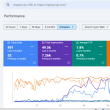
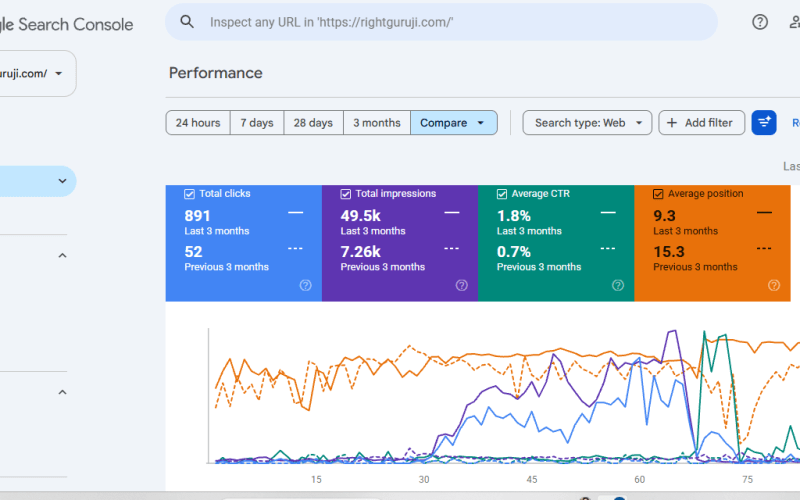
A recent three-month Google Search Console comparison shows an interesting example of SEO growth. The website generated 89 total clicks and 49.5K impressions during the last three months, compared with 52 clicks and 7.26K impressions in the previous three months. The average CTR also improved from 0.7% to 1.8%, while the average position improved from 15.3 to 9.3.
These numbers indicate positive progress, but they also show that there is still significant potential to improve organic performance.
What Does the Data Tell Us?
The biggest improvement can be seen in impressions. Increasing from 7.26K to 49.5K means the website is appearing in Google search results much more frequently.
Higher impressions are a positive signal because they show that Google is giving the website more search visibility. However, impressions alone do not mean that users are visiting the website.
The next step is to convert that visibility into clicks.
This is where CTR, rankings and search intent become important.
The average position has improved from 15.3 to 9.3, which is another strong sign. The website has moved considerably closer to the first page of Google.
Now the SEO strategy should focus on taking keywords that are already performing reasonably well and pushing them higher.
Focus on Keywords Ranking Between Positions 4–15
One of the biggest opportunities in SEO comes from keywords that are already ranking but have not yet reached the top positions.
For example, keywords ranking around positions 5, 7, 9 or 12 may have considerable potential.
Instead of immediately creating a new article, the existing ranking page should first be analyzed.
SEO professionals can improve these pages by:
- Understanding the search intent
- Improving the title and headings
- Adding useful missing information
- Strengthening internal links
- Updating outdated content
- Improving content structure
- Covering related topics naturally
- Reviewing competing search results
- Improving the overall user experience
The goal should be to move valuable keywords gradually:
Position 12 → 9 → 7 → 5 → Top 3
This approach can often be more efficient than publishing large amounts of new content without analyzing existing opportunities.
Improve CTR From Existing Impressions
The average CTR has improved from 0.7% to 1.8%, which is encouraging. However, with 49.5K impressions, there is still an opportunity to generate more clicks.
A page can receive many impressions but relatively few clicks because its title or description may not communicate the value of the result clearly.
Therefore, identify pages with:
High impressions + low CTR + ranking positions around 4–15
These pages should become priority targets.
Review the title and meta description to make sure they are:
- Relevant to the search query
- Clear and easy to understand
- Specific
- Useful to the searcher
- Accurate to the actual content
Clickbait should be avoided. The purpose is not simply to attract a click but to attract the right click from someone whose search intent matches the page.
Don’t Ignore Existing Content
A common SEO mistake is continuously publishing new articles while ignoring pages that are already generating impressions.
Before creating a new article, check Google Search Console to determine whether the website already has a page ranking for that topic.
If an existing page has impressions and ranking potential, improving it may be a better strategy.
This can also help reduce the risk of creating multiple pages that target the same search intent and compete with one another.
Build a Strong Internal Linking Structure
Internal linking should be an important part of the optimization process.
Related pages should be connected naturally so users can move from one topic to another.
For example:
Main Guide → Supporting Article → Detailed Topic → Relevant Service/Product Page
This structure can make navigation easier and help search engines understand the relationship between pages.
Internal links should always be relevant and useful. They should not be added simply to place keywords repeatedly.
Technical SEO Still Matters
Content is only one part of SEO. Technical health should also be monitored regularly.
Important areas include:
- Indexing
- XML sitemap
- Robots.txt
- Canonical URLs
- HTTPS
- Mobile usability
- Core Web Vitals
- Broken links
- Redirects
- Duplicate pages
- 404 errors
Google Search Console should be checked regularly to identify indexing or performance problems.
If a sudden drop appears in the performance graph, it should not immediately be considered a Google penalty. First, check the affected dates, pages and queries and investigate whether there was a technical problem, content change, ranking change or search-demand fluctuation.
Quality Backlinks and Authority Building
Off-page SEO can also contribute to long-term organic growth.
The objective should not be to collect hundreds of random backlinks. Instead, the focus should be on relevance, quality and trust.
Useful approaches can include relevant industry websites, digital PR, genuine guest contributions, useful resource pages and legitimate business profiles.
Spammy backlinks, automated link-building, irrelevant websites and excessive exact-match anchor text should be avoided.
A smaller number of relevant and trustworthy links can be more valuable than a large collection of low-quality links.
Prepare Content for Modern Search
SEO is also evolving beyond traditional blue-link rankings.
AEO and GEO strategies can be incorporated by creating content that provides clear answers and useful information.
Good content should include:
- Clear explanations
- Direct answers
- Step-by-step information
- Relevant comparisons
- Useful FAQs
- Logical headings
- Original insights
- Accurate and trustworthy information
The goal should not be to write content only for search engines or AI systems. The priority should always be to provide a useful experience for the reader.
What Should Be Done Next?
Based on this type of Search Console performance, the SEO workflow should be:
Analyze → Identify → Optimize → Monitor → Improve
First, analyze the queries and pages generating impressions.
Next, identify keywords ranking between positions 4–15.
Then optimize those pages for search intent, content quality, CTR and internal linking.
After that, monitor the changes and compare performance over time.
At the same time, continue technical SEO, competitor analysis, quality link building and new content creation where there is a genuine content gap.
Frequently Asked Questions
Is an increase in impressions good for SEO?
Yes. Increasing impressions generally means the website is appearing more frequently in search results. However, clicks, CTR and rankings should also be considered.
Is an average position of 9.3 good?
It is a positive improvement compared with 15.3. However, average position is an overall metric, so individual keywords and pages should be analyzed to understand the real opportunities.
How can CTR be improved?
Analyze pages with high impressions and low CTR. Improve their titles and meta descriptions while ensuring they accurately match the search intent and page content.
Should I create new content or update old content?
Both are useful. If an existing page already has impressions and ranking potential, optimizing that page should be considered before creating another page targeting the same topic.
Are backlinks still important?
Relevant, quality backlinks can support website authority. However, SEO should focus on quality and relevance rather than simply increasing backlink numbers.
How often should SEO performance be checked?
Important changes can be monitored regularly, but major decisions should be based on meaningful trends rather than a single day’s fluctuation. Monthly and three-month comparisons are useful for measuring broader progress.
Final Thoughts
The biggest lesson from Google Search Console is that SEO growth comes from continuous improvement.
The objective should not be to chase impressions alone. The real journey is:
Impressions → Rankings → CTR → Clicks → Engagement → Conversions
When visibility increases and average position improves, the next opportunity is to turn that progress into stronger rankings and more qualified organic traffic.
SEO is not about finding shortcuts. It is about analyzing data, understanding users, improving content, strengthening technical foundations and consistently making the website better.
Every impression is an opportunity. Every click is a signal. Every ranking improvement is progress.
The work continues with every new Search Console report.
Keep analyzing. Keep optimizing. Keep improving.
Connect With Me
I regularly share insights and practical experiences related to SEO, Search Visibility, Technical SEO, AEO, GEO and Organic Growth.
LinkedIn: indrajeet-sanwal
Facebook: indrajeetsanwal
APSense: indrajeetsanwal
— Indrajeet Sanwal
SEO Expert | Technical SEO | On-Page & Off-Page SEO | Local SEO | AEO & GEO