






The mobile application industry is evolving rapidly as startups, entrepreneurs, and enterprises continue searching for faster ways to launch scalable digital products. Creating an application entirely from the ground up usually necessitates thorough planning, significant development budgets, and lengthy production schedules. This is why businesses are increasingly choosing clone app development solutions to accelerate their market entry while minimizing technical risks.
Businesses Prefer Clone App Development
Faster Time to Market
Traditional app development can take months or even years to complete. Clone app solutions reduce development time because developers can use pre-built modules and tested frameworks. This allows businesses to launch applications quickly and capture market opportunities before competitors.
This fast launch capability provides businesses with a competitive advantage, especially in industries where timing plays a critical role. Businesses can often launch a fully functional platform within weeks because the core architecture and features are already pre-developed.
Reduced Development Costs
Developing a custom application from scratch requires large investments in design, backend systems, APIs, testing, and infrastructure. Clone app development minimizes these expenses because much of the architecture is already optimized.
This cost-effective approach is especially beneficial for startups and small businesses operating with limited budgets.
Proven Business Models
One of the biggest advantages of clone apps is that they are inspired by business models already validated in the market. Businesses do not need to spend excessive time testing whether the concept will work.
Instead, companies can focus on improving user experience, operational efficiency, and customer retention.
Scalability and Flexibility
Modern clone apps are highly scalable and flexible. Businesses can begin with essential features and later integrate advanced functionalities as customer demand increases.
Most clone applications support:
- Android apps
- iOS apps
- Web dashboards
- Vendor management panels
- Delivery partner applications
- Admin control systems
This flexibility helps businesses manage operations smoothly across multiple platforms.
Clone App Development Process
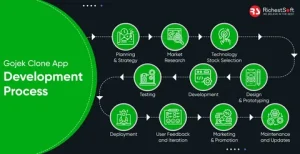
1. Market Research and Planning
The first step involves analyzing the reference application and understanding its features, monetization model, customer workflow, and operational strategy. Businesses must identify their target audience and decide which features they want to include or improve.
Proper market research helps companies understand customer expectations and competitor strategies.
2. UI/UX Design
The next stage focuses on creating an attractive and user-friendly design. Developers customize the application using unique branding elements such as logos, typography, color schemes, layouts, and navigation systems.
A strong UI/UX design improves customer engagement and enhances user retention.
3. Backend Development
Backend development is one of the most important stages in clone app development. Developers configure servers, databases, APIs, payment gateways, authentication systems, notifications, and GPS tracking features.
4. Testing and Quality Assurance
Before deployment, the application undergoes multiple testing processes to identify bugs and performance issues. Testing includes:
- Security testing
- Functional testing
- Compatibility testing
- Performance optimization
- User experience testing
This stage ensures the application delivers a smooth and reliable experience for users.
5. App Deployment
Once testing is completed, the application is deployed to app stores and cloud hosting platforms. Developers also configure analytics, monitoring systems, and performance tracking tools.
A successful deployment ensures the app is accessible and ready for users.
Popular Clone App Categories
Clone app development supports various industries and service models.
Ride-Booking Apps
uber clone apps include features like GPS tracking, fare estimation, route optimization, driver management, and online payments.
Food Delivery Apps
Food delivery applications support restaurant listings, live order tracking, customer reviews, and delivery management systems.
Grocery Delivery Apps
Grocery delivery clone apps allow businesses to provide hyperlocal delivery services with inventory management and real-time tracking.
Multi-Service Apps
Multi-service applications combine services such as transportation, parcel delivery, home services, and food delivery under one platform.
Conclusion
Clone app development has become one of the fastest and most cost-effective ways to launch scalable digital platforms. By using proven business models and tested frameworks, startups and enterprises can reduce development costs, accelerate deployment, and minimize technical risks.
From transportation and food delivery to healthcare and multi-service ecosystems, clone applications are transforming the on-demand economy. Businesses that focus on customization, scalability, security, and user experience can successfully build powerful applications and achieve long-term growth in competitive markets.
FAQ
1. What is clone app development?
Clone app development is the process of creating an application inspired by an existing successful platform while using original code and customized features.
2. Is clone app development legal?
Yes, clone app development is legal when developers avoid copying copyrighted assets, trademarks, and proprietary source code.
3. How long does it take to develop a clone app?
Development timelines vary depending on features and customization, but most clone apps can be built within a few weeks to several months.
4. Can clone apps be customized?
Yes, businesses can customize branding, payment systems, languages, features, layouts, and service categories according to their requirements.
5. Which industries commonly use clone app development?
Industries such as transportation, food delivery, grocery delivery, healthcare, eCommerce, and multi-service platforms commonly use clone app development solutions.