



Let us be direct about something the industry does not say enough. You can have a product on shelves at Walmart, Kroger, and Target all at once and still be losing money.
- Not because the product is bad.
- Not because the marketing failed.
But because nobody in your organization actually knows;
- what that shelf space is costing you,
- what your promotions are returning,
- or where your margins went after the distributor took their cut.
That is the CPG profitability problem in one paragraph, and it is far more common than the industry publicly admits.
Research from Bain & Company found that in the first half of 2024, the top 50 global brands posted only 1.2% year-over-year revenue growth, while smaller and less established companies captured 40% of the market’s overall growth (NetSuite). The opportunity is clearly there for emerging brands. But opportunity without financial clarity is just expensive guesswork. And in consumer packaged goods, expensive guesswork has a way of showing up as a brand that moves volume beautifully and still cannot make payroll.
The Trade Spend Black Hole Nobody Talks About
Here is where most CPG profitability conversations need to start, and almost never do. Trade spend. Trade expenditure frequently ranks as the second most significant cost for CPG firms following the cost of goods sold, and it is among the most misinterpreted entries on any profit and loss statement in the industry (Visual fabriq). We are talking about slotting fees, promotional allowances, co-op advertising, volume discounts, scan-backs, and billbacks. The list goes on, and every single item on it has a direct hit to your gross margin.
The numbers are serious. For CPG manufacturers, trade spend accounts for 15% to 25% of gross sales (Cpg vision). That is not a rounding error. That is a structural cost that shapes everything downstream. And yet, failing to properly account for trade spend can artificially inflate reported revenue and profitability and distort forecasts (NetSuite). In simple words, your business can look profitable on paper while the actual economics are quietly working against you. That is not a cash flow problem. That is an accounting problem.
The downstream effects of this mismanagement are well documented. Misclassifying contra revenue can lead to overstated topline and poor financial visibility (Trewup). And once visibility is gone, so is the ability to make sound decisions on pricing, promotion, and procurement. You are essentially flying a commercial aircraft on a compass from 1987.
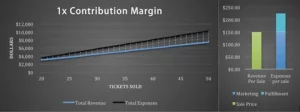
CFO Pro Analytics, after building trade spend ROI models for dozens of CPG brands, identified a recurring analytical error: using promoted volume as the success metric. Volume is not incremental profit. Promoted volume can grow while profitability declines if discounts, fees, and decay exceed the contribution margin from lift (CFO Pro Analytics). That one mistake, repeated across hundreds of SKUs and dozens of retail accounts, is enough to sink a brand that everyone in the building believes is performing well.
What Proper Accounting Actually Changes
The fact is, CPG-specific accounting is not the same as general business accounting. The industry has its own financial architecture, and brands that treat it like any other sector pay for that assumption. Inadequate accounting in CPG can lead to inconsistent cash flow, pricing errors, lower sales and profits, and compliance and regulatory issues (NetSuite). Those are not theoretical risks. Those are the specific failure modes of brands that grew fast, celebrated the velocity, and ignored the books.
Consider the cash conversion cycle alone. CPG businesses often wait 4, 5, or even 6 months to convert inventory into cash, while high upfront costs and delayed retailer payments create a challenging situation that rarely makes headlines (K-38 Consulting). Without an accounting function that is actively modeling that cycle, brands routinely run out of operating capital during their strongest growth periods. They get a big retailer, they fill the order, and they wait half a year to see the money. Nobody warned them. Nobody modeled it. The accounting was not there to do it.
Financial experts Alice Zhang and Eric Soncino, co-founders of my Pocket CFO, addressed this precisely in their industry webinar on financial statements for CPG brands. They emphasized that accrual accounting offers investors a comprehensive understanding of the company’s financial health, future profitability, and cash flow projections.
Customizing the chart of accounts to align with the business model and reporting needs facilitates more detailed tracking and analysis (My pocket cfo). That is not abstract advice. That is the difference between a financial system that surfaces problems early and one that surfaces them after the damage is done.
Trade promotions can consume 20-25% of gross sales in the CPG sector. Tracking ROI ensures promotional spend delivers incremental profits rather than just volume spikes (Desk era). Make sure that your accounting infrastructure is built to measure this with the granularity the number demands.
A blended trade spend ROI that looks acceptable at the company level can mask individual retailer relationships that are actively destroying value. CFO Pro Analytics worked with a sauce brand where the blended trade spend ROI was 1.1x. Retailer-level analysis revealed extreme variance, with one regional chain generating a 0.3x ROI, meaning it was returning 30 cents for every dollar invested in promotion (CFO Pro Analytics). Without the accounting to surface that, the brand would have continued funding a relationship that was quietly bleeding it dry.
CPG Outsourcing:
CPG outsourcing is the answer that more brands are finding their way to. Partnering with a trusted outsourcing provider can reduce expenses while delivering high-quality accounting services tailored to the CPG sector, with some providers helping clients achieve up to 60% savings compared to in-house U.S. counterparts (Expertise accelerated). That is not a marginal improvement. That is a structural shift in the cost of financial clarity.
That is why consumer packaged goods procurement services and outsourced accounting are increasingly part of the same conversation. According to Deloitte’s 2025 Chief Procurement Officer Survey, organizations that invest in digital procurement tools now allocate up to 24% of their budgets to procurement technology, and those leaders achieve 3.2 times higher ROI on AI investments than their peers (Fusion CX). Brands that treat procurement and accounting as a connected, strategic function rather than a back-office cost center are the ones pulling away from the competition.
Outsourced CPG finance teams provide clear visibility into inventory and demand, streamline accounting, track expirations, and support SKU rationalization to fix inventory issues, while also helping brands prepare for major moves like retail expansion, fundraising, or acquisition (Eisner Amper). All in all, that is the kind of support that lets a founding team focus on growth rather than reconciling deduction disputes with a spreadsheet at midnight.
Build the Financial Foundation Before You Need It
The CPG brands that win over the long term are not always the ones with the most creative products or the biggest marketing budgets. They are the ones who knew their numbers. Knew which SKUs were actually profitable. Knew what every retail relationship was really costing them. Knew when cash was going to be tight before it got tight.
That kind of knowledge does not come from a good salesperson or a strong operations team. It comes from accounting that is built for the specific complexity of this industry. Get the financial foundation right. Everything else will have a much better chance of standing on it.