



Something is changing inside laboratories, but it rarely gets talked about openly. Task demands are expanding, expectations are elevating, and the pressure to produce quicker, more precise outcomes continues to escalate. In many labs, traditional workflows are starting to show strain. Slides still pile up on desks. Analysis still takes time. However, the difference today is that teams are starting to question whether their tools are still enough. As a result, researchers and procurement teams looking at microscopes for sale are no longer just comparing magnification or price. Instead, they are focusing on smarter, AI Microscopes solutions that can keep up with modern scientific demands. This shift is not driven by curiosity. It is driven by necessity.
The Hidden Limitations of Traditional Microscopes
Traditional microscopes have served science well for decades. They are reliable, familiar, and widely used. However, their limitations become clear in high-volume environments.
- First, manual observation leads to fatigue. As the day progresses, even experienced technicians may lose focus. This can impact consistency, especially when reviewing large numbers of slides.
- Second, manual tasks like cell counting consume significant time. What should be a quick process often turns into hours of repetitive work. Over time, this slows down the entire workflow.
- Third, traditional systems lack integration. Data is often recorded manually, which increases the risk of human error. Important findings may sit in notebooks instead of flowing into digital lab systems.
- In addition, onboarding new staff takes time. Without automated support, beginners rely heavily on supervision. This slows productivity and increases training demands.
- Finally, scalability becomes a challenge. When sample volume increases, the only solution is usually more staff and longer hours. This is not efficient in modern high-demand environments.
Taken together, these issues create a clear bottleneck in many laboratories.
AI Microscopes Change the Workflow
AI microscopes are not just upgraded versions of traditional tools. They introduce a completely different way of working. Instead of relying only on human observation, they combine imaging with intelligent analysis. One of the biggest advantages is speed. AI systems can scan and analyze slides in minutes. This dramatically reduces turnaround times, especially in busy diagnostic labs.
Consistency is another key improvement. Unlike human observers, AI systems apply the same standards every time. This removes variation caused by fatigue or subjective judgment. Automation also improves documentation. Images, measurements, and reports are generated automatically. This reduces manual entry and frees up time for more meaningful analysis. Furthermore, AI assistance enables junior employees to complete tasks with greater confidence. The system highlights areas of interest and supports interpretation. As a result, teams become productive much faster. Most importantly, these systems scale easily. When workload increases, AI microscopes handle higher volumes without requiring proportional increases in staff.
Real-World Applications Across Industries
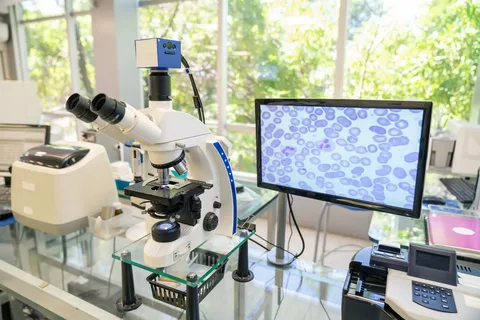
AI microscopes technology is already being used across multiple fields, and the impact is becoming more visible. In hospitals and diagnostic labs, pathologists use AI tools to analyze tissue samples, detect abnormalities, and review blood smears more quickly. Faster analysis often leads to faster treatment decisions, which can directly affect patient care.
In universities and research institutions, repetitive tasks such as slide scanning and measurement are increasingly automated. This allows researchers and students to focus more on interpretation and scientific insight rather than manual data collection. In pharmaceutical and biotech industries, precision is essential. AI microscopes help track cell behavior, monitor experiments, and maintain consistency across long research cycles. This improves both accuracy and efficiency in drug development.
Manufacturing and quality control environments also benefit. Whether inspecting semiconductors or pharmaceutical products, AI systems help identify defects at scale with high accuracy. Environmental and industrial testing labs use similar systems to analyze water samples, soil, and microorganisms. Large sample volumes can be processed quickly without sacrificing reliability. Across all these industries, the reason for adoption is consistent: traditional workflows can no longer keep up.
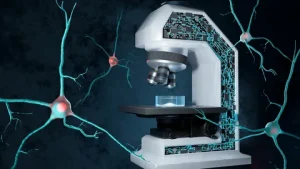
Traditional vs AI Microscopes
When comparing both systems, the differences become clear in daily operations. Traditional microscopes rely heavily on human interpretation. This means results can vary depending on experience, fatigue, and workload. In contrast, AI microscopes standardize analysis and reduce subjectivity.
Data handling is another major difference. Traditional setups often require manual logging, which increases the chance of transcription errors. AI systems automatically store and organize data in digital formats. Operator skill requirements also differ. Traditional systems demand experienced users for reliable results. AI systems, however, support newer users through automated guidance and analysis suggestions.
Cost is often a key consideration. Traditional microscopes may appear cheaper initially. However, when labor time, training, and inefficiencies are included, AI systems often become more cost-effective over time. In short, traditional tools still work well for light use. But in high-demand environments, AI systems offer a clear operational advantage.
What Labs Should Consider Before Upgrading
Switching to AI-based microscopy is not just a hardware decision. It requires careful planning.
- First, labs should clearly define their use case. Clinical diagnostics, research work, and industrial testing all require different AI capabilities.
- Second, software compatibility is important. The microscope must integrate with existing lab systems to ensure smooth data flow.
- Third, long-term updates should be considered. AI systems improve over time through software enhancements, so vendor support matters significantly.
- Finally, total cost should be evaluated realistically. This includes licensing, maintenance, training, and operational savings over time.
A thoughtful evaluation ensures the right investment decision.
The Ongoing Transition in Modern Science
Traditional microscopes are not disappearing. They still play a role in many settings. However, their dominance is slowly declining in high-performance environments. Modern laboratories are under pressure to deliver faster results, handle larger volumes, and maintain higher accuracy. AI-integrated microscopes help meet these demands more effectively. This transition is not happening because the technology is new or trendy. It is happening because existing systems are reaching their limits.
As laboratories continue to evolve, the gap between traditional tools and AI-driven systems will only grow wider. Organizations that adapt early are likely to see stronger efficiency, better accuracy, and improved research outcomes. In the end, the shift is already underway. The question is no longer whether AI microscopes will become standard, but how quickly the rest of the industry will catch up.