



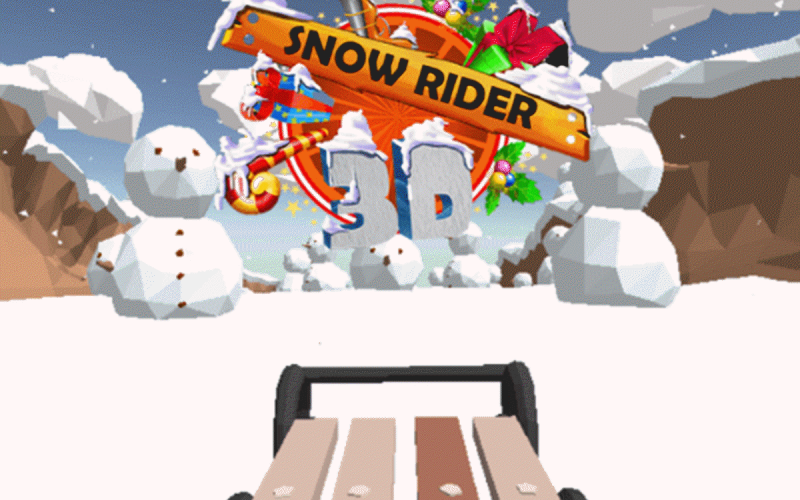
At first glance, Snow Rider 3D looks like a straightforward holiday-themed game. You hop on a sled, glide down a snowy mountain, dodge some trees, and grab gifts. However, anyone who has played for more than five minutes knows the truth: it is a high-speed test of mental endurance and precision. As your sled picks up velocity, the margin for error shrinks to almost zero. Success in this game isn’t just about having “gamer reflexes”; it’s about rhythm, strategy, and staying calm under pressure.
If you want to stop crashing into snowmen and start setting records, use these professional tips to dominate the mountain.
1. The Power of the Center Lane in Snow Rider 3D
One of the most common mistakes beginners make is “edge-hugging.” While it might feel safer to stay far to the left or right, you are actually cutting your escape options in half.
The center of the track is your “Home Base.” From the middle, you have 360-degree mobility to dodge in either direction. Only deviate from the center when you absolutely must:
-
To snag a gift that is safely positioned.
-
To navigate around a massive cluster of obstacles.
-
To reset your line after a previous dodge. Once the path clears, immediately drift back to the middle.
2. Master “Micro-Movements”
When speed increases, panic sets in. Most players react by slamming the directional keys or swiping wildly. This leads to overcorrection, which usually sends you straight into the very tree you were trying to avoid.
Instead, practice gentle taps. The goal is to move just enough to clear the obstacle and no more. Think of it as “gliding” rather than “turning.” By using the smallest input possible, you keep the sled stable and your momentum predictable.
3. Scan the Horizon (The 30% Rule)
Stop looking at your sled. If you are staring at the bottom of the screen, you are playing catch-up. Skilled players focus their eyes about one-third of the way up the screen.
By scanning the horizon, you can identify “lanes” before you even reach them. Your brain needs time to process the randomized patterns of rocks and fences. Looking ahead essentially slows the game down, giving you a massive advantage in reaction time.
4. Recognize Repeating Patterns
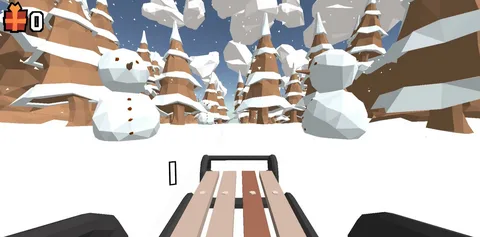
While the course is procedurally generated, the game uses specific “obstacle modules” that repeat. If you play enough, you’ll recognize common traps:
-
The Narrow Gateway: Two trees with a tiny gap in the middle. (Align early and stop moving).
-
The Fence Zig-Zag: Fences that force you to move from far left to far right.
-
The Snowball Surprise: Large boulders that appear suddenly after a long open stretch. Once you recognize the pattern, your hands will move automatically, freeing up your focus for the next obstacle.
5. Don’t Let Greed End Your Run
Gifts are tempting because they unlock new sleds, but a single gift is never worth a “Game Over.” Many players crash because they chase a gift tucked behind a rock.
Prioritize survival over pickups. If a gift looks risky, let it go. Long, successful runs naturally accumulate more gifts than short, risky ones. Stay alive, and the points will follow.
6. Develop a “Slopestyle” Rhythm
At peak speeds, manual reaction becomes impossible. You have to enter a “flow state.” Instead of thinking, “There is a tree, I must go left,” try to find a rhythmic cadence.
-
Relax your grip on the controller or keyboard.
-
Breathe steadily.
-
Think of the movement as a dance: Left-center, Right-center. Rhythm prevents the “freeze” response that happens when the screen gets crowded with hazards.
7. Recovering from a “Near-Miss”
The “Chain Reaction Crash” is a real phenomenon. You barely dodge a rock, you panic, you oversteer, and you hit a tree. If you have a close call:
-
Don’t jerk the controls.
-
Slowly guide the sled back to a neutral path.
-
Reset your vision to the horizon. Staying calm after a mistake is what separates the top 1% of players from everyone else.
Technical Tips for Better Performance
Use Full-Screen Mode
Visual noise is your enemy. Playing in a small browser window can lead to distractions. Switching to full-screen increases your “visual real estate,” making obstacles appear slightly larger and giving you more time to react.
Check Your Hardware
Different devices offer different levels of precision.
-
Keyboards are generally best for Snow Rider 3D because “tapping” a key provides a binary, clean input.
-
Touchscreens can be great but suffer from “finger friction” which can slow you down. Find what feels most responsive for you and stick with it.
Warm-Ups Matter
Don’t expect to hit a high score on your first run of the day. Your brain needs a few “throwaway” rounds to calibrate to the game’s physics and speed. Use your first three runs just to get a feel for the sled’s weight before you try to break your record.
Advanced Tactics: Lane Reading
The most elite players don’t see obstacles; they see lanes. Instead of dodging a tree, they see a clear “highway” through a forest.
-
Minimal Input: Try to complete an entire section of the map moving the sled as little as possible.
-
Trajectory Locking: Once you have lined up for a narrow gap, take your hands off the controls. Trust your trajectory. Most players crash because they keep adjusting while they are inside the gap.
Final Thoughts: The Mental Game
Snow Rider 3D is a psychological challenge. As you get closer to your high score, your heart rate will climb, and your palms will get sweaty. This is when “tunnel vision” sets in, causing you to stare at a single obstacle while ignoring the rest of the screen.
Stay loose, keep scanning, and remember that survival is the only goal. If you feel your reactions getting sluggish, take a five-minute break. You’ll find that returning with fresh eyes usually leads to a new personal best. Now, get back out there and conquer the mountain!