



The global precast concrete market has become an essential part of the modern construction industry. It supports faster, safer, and more efficient building methods in both residential and commercial projects. Precast concrete refers to structural components that are manufactured in a controlled factory environment and later transported to construction sites for assembly. This method offers several advantages over traditional construction. It improves quality control, reduces on-site labor, and speeds up project completion. At the same time, it ensures higher durability and better structural performance.
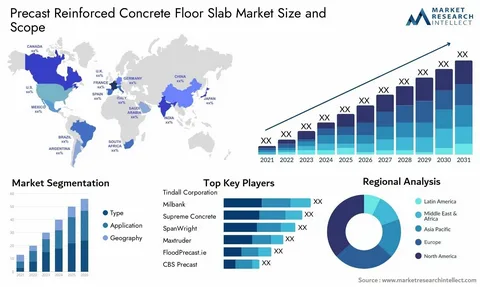
In 2023, the global precast concrete market was valued at USD 125.32 billion. It is expected to grow to USD 132.37 billion in 2024 and reach USD 202.55 billion by 2031. This reflects a steady CAGR of 6.26% during the forecast period. Growth is driven by rapid urbanization, infrastructure development, and rising demand for efficient construction solutions.
Key Highlights of the Precast Concrete Market
The precast concrete industry is expanding steadily due to rising global construction needs. Several key highlights define its growth:
- Strong demand for modular and prefabricated construction methods
- Increasing use in infrastructure projects such as bridges, highways, and railways
- Faster construction timelines and reduced labor dependency
- Asia-Pacific leading global market expansion
- Growing adoption of sustainable and low-waste construction practices
- Technological improvements in manufacturing and design processes
These factors are reshaping how buildings and infrastructure are developed worldwide.
Market Drivers Supporting Growth
Several strong drivers are fueling the growth of the precast concrete market. Each driver is closely linked to global development trends and construction modernization. One of the main drivers is rapid urbanization. Growing urban populations are increasing the demand for housing, commercial spaces, and public infrastructure. Governments are investing heavily in smart cities, transportation systems, and affordable housing projects, all of which rely on precast concrete components for faster execution.
Another major driver is cost and time efficiency. Precast concrete elements are manufactured in advance while site preparation takes place simultaneously. This parallel process significantly reduces project delays. It also lowers labor costs and improves construction accuracy.
Sustainability is also a key growth factor. Precast concrete supports eco-friendly construction by reducing material waste and minimizing on-site pollution. Its controlled manufacturing process also helps reduce carbon emissions, aligning with global green building standards.
Market Restraints and Challenges
Despite strong growth, the precast concrete market faces certain limitations. Setting up precast manufacturing facilities requires significant capital, which can be difficult for small and medium contractors.
Transportation is another challenge. Precast components are heavy and require special logistics, which increases overall project costs. In addition, some regions face a shortage of skilled labor and lack standardized regulations. These factors can slow down adoption in developing construction markets.
Emerging Trends in the Precast Concrete Industry
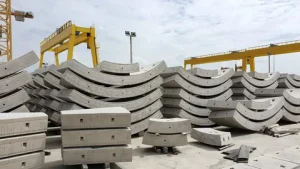
The precast concrete market is evolving quickly due to technological and design advancements. One major trend is the adoption of automation. Robotics and digital systems are improving production speed and accuracy while reducing human errors. Building Information Modeling (BIM) is also becoming widely used. It helps engineers and architects plan projects more efficiently and coordinate better between design and construction teams.
Another important trend is the rise of modular construction. Precast concrete plays a key role in modular buildings such as apartments, hospitals, hotels, and schools. This method reduces construction time and improves scalability.
Architectural customization is also increasing. Modern precast solutions allow designers to create complex shapes, textures, and finishes. This adds aesthetic value without compromising strength or durability.
Market Segmentation Analysis
The precast concrete market is segmented based on product type, construction type, and end-use industry. Each segment contributes differently to overall market growth. By product type, walls and panels hold a significant share. They are widely used in residential and commercial buildings due to their strength and easy installation. Other key segments include columns, beams, floors, roofs, and girders.
By construction type, permanent modular construction is gaining strong momentum. It is widely used in large-scale housing and infrastructure projects because of its speed and efficiency. By end-use industry, the infrastructure segment dominates the market. Governments across the world are investing in transportation networks, public utilities, and urban development projects. Residential and commercial construction also contribute significantly to demand.
Regional Insights of the Precast Concrete Market
Asia-Pacific leads the global precast concrete market and is expected to maintain the highest growth rate. Rapid urbanization, population growth, and large-scale infrastructure projects in China, India, and Southeast Asia are driving this dominance. North America holds a strong market position due to advanced construction technologies and increasing infrastructure renovation activities. The United States and Canada are key contributors.
Europe is a mature market with strict environmental regulations and strong demand for energy-efficient buildings. Countries like Germany, France, and the United Kingdom are leading adopters of precast solutions.
Latin America is growing steadily, supported by investments in transportation and housing development. Brazil and Mexico are essential markets in this area. The Middle East and Africa are also expanding, driven by smart city projects and large infrastructure investments in countries like the UAE and Saudi Arabia.
Competitive Landscape and Key Players
The precast concrete market is moderately fragmented, with both global corporations and regional manufacturers competing. Companies are focusing on expanding production capacity, improving technology, and strengthening distribution networks.
Many players are investing in research and development to improve durability, sustainability, and performance of precast products. Strategic partnerships and acquisitions are also common to expand global presence. Leading companies include global construction material manufacturers and specialized precast solution providers that focus on innovation and efficiency.
Future Outlook of the Precast Concrete Market
The future of the precast concrete market looks highly promising. Growing construction activity, increasing urban development, and rising demand for faster building solutions will continue to drive growth.
Technological advancements will play a major role in shaping the industry. Automation, smart manufacturing systems, and digital design tools will improve efficiency and reduce costs. Sustainability will also remain a key focus. The demand for eco-friendly construction materials and low-carbon building methods will further boost precast concrete adoption. Emerging economies will continue to drive expansion, while developed regions will focus on renovation and infrastructure upgrades.
Conclusion
The global precast concrete market is set for strong and sustained growth through 2031. Increasing urbanization, infrastructure investments, and the shift toward efficient construction methods are driving demand worldwide.
With a projected market value of USD 202.55 billion by 2031, precast concrete will remain a key pillar of modern construction. Companies that adopt innovation, automation, and sustainable practices will gain a strong competitive advantage in this evolving global market.