






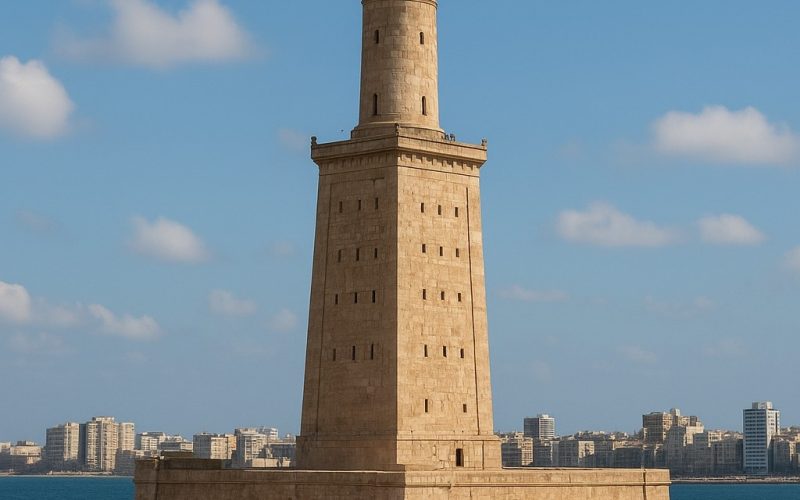
The Lighthouse of Alexandria, or Pharos Lighthouse, is in Egypt. It has fascinated historians, travelers, and archaeologists for centuries. It is considered one among the seven natural wonders of the World of Ancient Times.
- It shows great engineering skills
- Maritime activities were important.
Today, researchers are still studying the location of the Pharos Lighthouse in Egypt. They want to learn how this important structure influenced ancient navigation and coastal life in the Mediterranean.
A Symbol of Ancient Innovation
Workers built the Pharos Lighthouse in Egypt during the reign of Ptolemy II Philadelphia in the 3rd century BCE. It once stood about 100 to 130 meters above sea level.
Its tall structure helped ships find their way to the busy port of Alexandria. This port was one of the most important trade centers in the ancient world. Earthquakes caused its collapse, but the lighthouse’s legacy still helps us understand ancient architecture and maritime history.
Where exactly does the Lighthouse in Egypt locate?
Many people now believe that the Pharos Lighthouse in Egypt stands on the eastern tip of Pharos Island. This area is part of present day Alexandria. In antiquity, builders connected Pharos Island to the mainland by constructing the Heptastadion, a massive causeway. This strategic location let the lighthouse in Egypt act as a guiding light and a symbol for the city.
Today, the site lies near the Qaitbay Citadel, a 15th century fortress built directly over the lighthouse’s ruins. Archaeological evidence—including massive stone blocks, statues, and architectural remnants found underwater—supports this precise location. These discoveries help us understand how the beacon worked. They also show how it fit into Alexandria’s city and coast.
Underwater Discoveries and Ongoing Research
Underwater archaeology has made a substantial addition to our understanding of the location of Egypt’s Pharos Lighthouse. Since the 1990s, teams of explorers have mapped and photographed submerged ruins scattered around the Qaitbay harbor area. Among these findings are:
- Granite columns and blocks thought to be part of the lighthouse’s base
- Carved statues representing rulers and deities
- Architectural fragments suggesting a multi-tiered structure
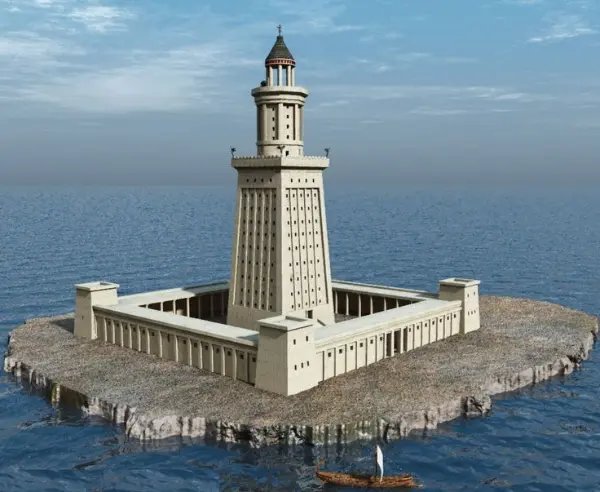
These discoveries support historical accounts of the lighthouse in Egypt. It had three floors. The base was square, the middle tower was octagonal, and the top tier was circular. This top part held the fire and the reflective mirror system.
Ongoing studies continue to examine how shifting coastlines, seismic activity, and centuries of harbor development have altered the landscape. Despite the challenges, the site remains one of the most active archaeological zones in Egypt.
In its zenith, the Pharos Lighthouse was an essential signpost for mariners traversing the Mediterranean. By using fire at night and polished bronze mirrors during the day, the structure served as one of the first long distance navigation aids. Its visibility extended several miles offshore, significantly reducing the dangers of entering Alexandria’s harbor.
The lighthouse in Egypt also symbolized technological progress. Historians think that building it needed complex engineering skills. It required precisely cut stones and advanced knowledge of optics and wind resistance.
Cultural Significance and Modern Interpretations
Beyond its functional role, the lighthouse held deep cultural significance. Ancient writers described it as a marvel that showcased the power, wealth, and ambition of the Ptolemaic dynasty. Its presence made Alexandria a visual and intellectual center of the Mediterranean civilization.
Today, the site continues to inspire reconstruction projects, museum exhibitions, and virtual models based on archaeological data. These modern interpretations help visitors and scholars see what the lighthouse may have looked like. They also show how it shaped the identity of ancient Alexandria.
Visiting the Historic Location Today
Travelers who want to see the historic Pharos Lighthouse in Egypt can visit the Qaitbay Citadel in Alexandria. The surrounding harbor area offers a blend of modern coastal life and glimpses into the city’s rich history. The lighthouse has disappeared, but its legacy endures. You can see it in local exhibits, archaeological finds, and views of the Mediterranean.
As ongoing research uncovers more details, the site continues to enrich global understanding of ancient engineering and maritime culture.
What You Can See There
While the lighthouse no longer exists, you will find:
- Qaitbay Citadel built over the lighthouse’s ruins
- Views of the Mediterranean Sea from the fortress walls
- Underwater remnants of the lighthouse visible during diving tours
- Nearby museums displaying artifacts recovered from the site
For a deeper experience, you can even book:
Optional: Underwater Diving Tours
Some dive operators in Alexandria offer guided dives where you can see:
- Granite blocks
- Statues
- Architectural fragments of the lighthouse
FAQs
1. Where was the Pharos Lighthouse located in Egypt?
The builders located the Pharos Lighthouse on Pharos Island, just off the coast of Alexandria, Egypt. It stood by the entrance of the old harbor. It acted as a guide for sailors on the Mediterranean Sea.
2. Can visitors see any original remains of the lighthouse today?
While the lighthouse no longer stands, many of its remnants lie underwater near the Qaitbay Citadel. Local museums showcase some findings.
3. What caused the lighthouse in Egypt to collapse?
A series of strong earthquakes happened between the 10th and 14th centuries. They caused a lot of damage and led to complete destruction.
4. How do archaeologists study the underwater ruins?
They use sonar mapping, diving surveys, 3D modeling, and underwater photography to identify and analyze submerged artifacts.
5. Is the exact location fully confirmed?
Yes, most evidence points to the site beneath the Qaitbay Citadel, supported by both historical accounts and archaeological discoveries.