




Planning within Dynamics 365 CRM setups may appear to be straightforward. As a matter of fact, it is discontinuous and ineffective. There are several tools used by teams to control the availability, meetings, and distribution of resources. This forms silos, which postpone execution. Important decisions are reached without a complete understanding of workloads or priorities. This leads to delays, and coordination is achieved manually at all times.
It centralizes scheduling within the CRM itself. It is a system that puts the scheduling in the CRM itself. It links time, resources, and business context at a single location. This enables the teams to work more quickly and collaboratively, and make wise decisions regarding scheduling without having to switch systems.
Why Traditional Scheduling Methods Break Down in CRM Environments?
The historic scheduling systems did not support integrated CRM systems. They are dependent on fragmented tools and manual coordination. This generates inter-team gaps. In the long run, these loopholes make the task less visible, slower, and affect the overall performance.
Calendars in other systems are controlled by sales, service, and operations. These tools lack means of communication. Real-time availability or changing priorities can not be noticed by teams. Consequently, communication requires an extensive use of messages and follow-ups, thus delaying the time of scheduling decisions and causing friction.
Meetings are commonly set out of the context of CRM. The teams do not take into account the customer priority, deal stage, or case urgency. The result of this is poor time allocation. Tasks with a high impact can be put on hold, and those that are not so important will take up the valuable time slots.
Such problems increase the time for coordination among teams. Time clashes become a common occurrence. Time limits are not met, and the risks of SLA increase. Deadlines are missed, and SLA risks grow. Duplicate bookings and last-minute changes disrupt workflows, reducing productivity and affecting the overall customer experience.
What Is a Shared Calendar in Dynamics 365?
A Dynamics 365 shared calendar is not necessarily a scheduling application. It is a coordination layer that is centrally constructed in CRM. It relates business data to calendars. This will guarantee that decisions on scheduling are always situational.
Core Concept
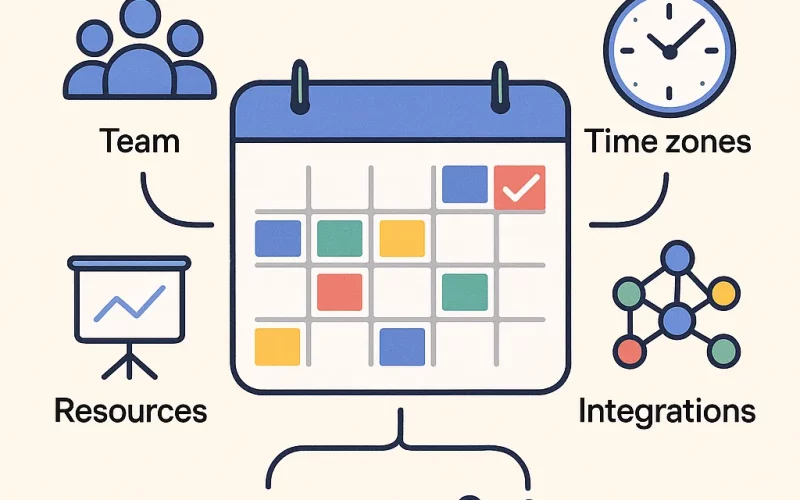
It is fundamentally a calendar based on Dataverse. It gives a single perspective of time, resources, and activities in the organization.
It brings together:
- Users
- Teams
- Resources
This brings about a single source of scheduling truth.
Key Capabilities
Dynamics 365 calendar helps with advanced scheduling requirements:
- Live status monitoring of teams.
- Role-based access to control visibility
- Native connectivity to Outlook and Microsoft Teams.
- Direct connection of events with CRM records, such as cases, opportunities, and projects.
The combination of these makes an otherwise difficult manual coordinating process into a data-driven, structured process in terms of scheduling.
How a Shared Calendar Improves Team Collaboration?
Working together enhances performance when the teams work with a united vision and synchronization in time. There is a Dynamics 365 common calendar that eliminates silos. It produces a shared scheduling interface that links departments and creates ease of daily operations.
Unified Visibility Across Teams
There is a common perspective on schedules in departments among the teams. They are able to check availability, workloads, and planned activities at the moment. This eliminates guesswork. It also makes a person less dependent on emails or messages. The team of workers is able to plan faster since all the details related to scheduling are in a single location.
Faster Cross-Functional Coordination
Coordination among sales, support, and operations is more formalized. Teams are able to synchronize the schedules without delays. The planning of joint meetings, escalation, and handoff is less complicated. This enhances the speed of execution. It also maintains the alignment of the various departments throughout the customer lifecycle.
Reduced Communication Overhead
A common calendar reduces the communication that has to take place all the time. No longer does a team have to inquire as to what is available. The process of scheduling is self-service. This reduces internal noise. It also enables the teams to concentrate more on doing rather than coordinating, which enhances productivity.
Improved Accountability and Ownership
The visibility is positive and makes teams more accountable. People can all tell who has to do what and when. This reduces ambiguity. There are fewer chances of missing tasks. It also makes ownership very clear, which enhances consistency of follow-through and execution.
Better Alignment with Business Priorities
Schedules are not made anymore in solitude. Teams are able to match the activities to the business priorities, like high-value deals or urgent cases. This will make sure that urgent tasks are given priority. It also assists organizations in creating time during which it had the greatest influence.
How It Improves Scheduling Efficiency?
A Dynamics 365 shared calendar allows better scheduling, combining real-time visibility and automation. It eliminates manual dependencies and, furthermore, it makes sure that all decisions made about scheduling are supported by correct data. The result is improved utilization and execution of the available resources.
Real-Time Availability and Conflict Reduction
Teams are able to see real-time user and resource availability. This will remove the possibility of using manual checks. The conflicts are discovered immediately, and the teams can change the schedules in advance.
- Scheduling conflicts are automatically identified.
- The best time slot selection.
- Fewer last-minute changes and double bookings.
Better Resource Allocation
The allocation of resources in a real capacity and capability makes scheduling more strategic. This guarantees even distribution of work and better utilization.
Tasks can be allocated based on:
- Availability
- Current workload
- Required skillsets
This method will eliminate the problem of overbooking and also make sure that the right individual is in the right activity.
Workflow-Driven Scheduling
Scheduling can be integrated into the business processes. This eliminates human intervention and provides process uniformity.
- Case creation → automatic time slot assignment
- Opportunity stage → triggers follow-up scheduling.
- Scheduling can be scheduled using rules with integration to Power Automate.
This forms a systematic and scalable scheduling system for Dynamics 365.
Practical Use Cases
With a Dynamics 365 shared calendar, it is flexible for various business operations. It links scheduling and real-time information and operational priorities. This guarantees the ability of teams to plan efficiently with fewer delays and interdepartmental coordination work.
Customer Support Teams
The support team is able to organize and handle the interaction with the customers directly in CRM. This enhances the response time and consistency.
- Schedule calls, follow-ups, and resolutions
- Resource allocation according to case urgency and priority.
- Guarantee adherence to SLA schedules without human intervention.
Sales Teams
Sales teams benefit from synchronized scheduling across stakeholders. This enhances the progress of deals and minimizes opportunities that are missed.
- Internal discussions, coordinator demos, and follow-ups.
- Match availability amongst various team members.
- Make sure that you are involved in time during the sales cycle.
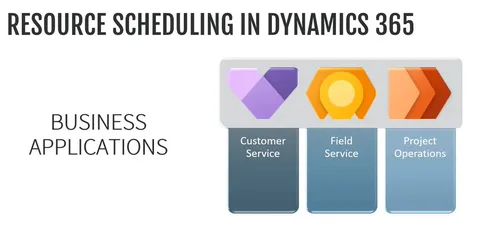
Field Service Operations
Team visits in the field can be planned more accurately. Scheduling takes into account the availability and location.
- Move technicians depending on the proximity and availability.
- Tour optimization to minimize travel time.
- Reduce service scheduling delays and enhance service efficiency.
Conclusion
A Dynamics 365 shared calendar is not a scheduling tool. It is a very important collaboration and work efficiency layer. But its actual worth is determined by the success of its implementation and integration.
This is the area where AppJetty can do some quantifiable good. AppJetty helps the Dynamics 365 calendar to be advanced through integrations and customizations. It guarantees a smooth synchronization, increased visibility, and workflow-based scheduling.
Businesses no longer need to stop at simple scheduling and develop a system that is fully connected.
Using AppJetty, the companies will be able to change the currently disrupted coordination of the entities into a structured, efficient, and scalable framework for scheduling, supporting the growth in the long term.