







Introduction
In today’s fast-evolving energy landscape, businesses across industries are striving to become more efficient, sustainable, and data-driven. As energy costs rise and sustainability targets tighten, energy management software has become a critical tool for optimizing consumption and reducing waste.
However, when organizations decide to adopt such systems, a major question arises should they choose a cloud-based energy management solution or an on-premise one?
This decision impacts not just cost and scalability, but also security, compliance, and long-term ROI. In this article, we’ll compare both models in depth and help you decide which deployment approach fits your business best.
Understanding Energy Management Solutions
Before diving into deployment models, it’s important to understand what energy management software actually does.
An energy management system (EMS) helps organizations track, analyze, and optimize their energy consumption. It collects data from multiple sources — such as sensors, IoT devices, building systems, and production lines to identify inefficiencies and reduce energy waste.
A modern EMS developed by an expert energy management software development company typically includes:
- Real-time energy monitoring dashboards
- Predictive analytics for demand forecasting
- Automated alerts for anomalies or excessive usage
- Integration with IoT devices and smart meters
- AI-driven recommendations for optimization
- Sustainability reporting tools
While these features are universal, the deployment model—whether cloud-based or on-premise—determines how the system operates, scales, and interacts with your existing infrastructure.
What Is a Cloud-Based Energy Management Solution?
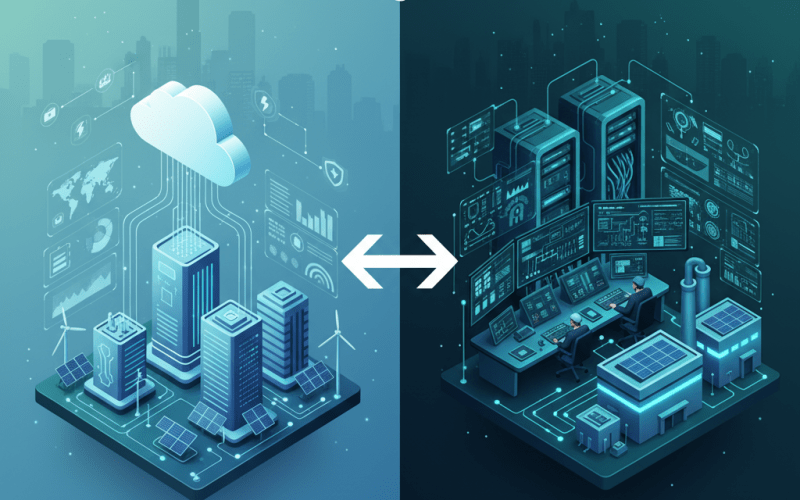
A cloud-based EMS is hosted on remote servers and accessed over the internet. The software provider (or a third-party cloud service like AWS, Azure, or Google Cloud) handles hosting, maintenance, and updates.
Organizations using cloud-based EMS typically pay on a subscription or SaaS (Software-as-a-Service) basis.
Key Benefits of Cloud-Based EMS
1. Scalability and Flexibility
Cloud-based systems are highly scalable. As your organization grows, new users, facilities, or sensors can be added with minimal setup. This is especially useful for enterprises with multiple sites across cities or countries.
2. Lower Upfront Costs
Since there’s no need for physical servers or expensive IT infrastructure, cloud deployments have a lower capital expense (CAPEX). You only pay operationally for what you use, making it ideal for startups and mid-sized firms.
3. Automatic Updates and Maintenance
Your cloud vendor handles software updates, data backups, and performance optimization. This frees up your IT team to focus on core business functions rather than managing system upgrades.
4. Remote Accessibility
Energy data can be accessed anytime, anywhere via web or mobile dashboards. Facility managers and executives can monitor performance across all locations in real time.
5. Faster Deployment
Cloud-based EMS can be deployed within days or weeks compared to months for traditional setups. This allows organizations to start optimizing energy use almost immediately.
Potential Drawbacks of Cloud-Based EMS
- Data Security Concerns: Although top-tier providers offer encryption and multi-layer security, some industries (e.g., defense or healthcare) prefer local control over sensitive energy data.
- Internet Dependency: Continuous internet access is required for full functionality.
- Ongoing Subscription Fees: While initial costs are lower, long-term subscription expenses can add up.
What Is an On-Premise Energy Management Solution?
An on-premise EMS is installed locally on an organization’s servers or data centers. All data storage, maintenance, and upgrades are managed in-house by the company’s IT team.
This model is often chosen by enterprises with strict data governance requirements or those operating in regions with limited internet connectivity.
Key Benefits of On-Premise EMS
1. Full Control Over Data
Organizations retain complete control of their energy data. This is critical for industries that handle sensitive or classified information, such as defense, government, and manufacturing.
2. Enhanced Security Customization
Since all infrastructure is internal, security configurations can be tailored according to specific enterprise standards and regulatory frameworks.
3. Integration with Legacy Systems
On-premise solutions often integrate better with legacy enterprise systems (like ERP or SCADA), which can be crucial for older industrial facilities.
4. One-Time Licensing Costs
While the upfront investment is higher, there are no recurring subscription fees, which may make financial sense over a long operational lifespan.
Potential Drawbacks of On-Premise EMS
- High Initial Cost: Requires investment in hardware, licenses, and IT personnel.
- Limited Scalability: Expanding capacity often means purchasing more servers and infrastructure.
- Slower Deployment: On-premise systems can take months to configure and implement.
- Manual Updates and Maintenance: The IT team must manage patches, backups, and troubleshooting, increasing operational burden.
Cloud vs. On-Premise: A Feature-by-Feature Comparison
| Feature | Cloud-Based EMS | On-Premise EMS |
|---|---|---|
| Deployment Speed | Fast (days to weeks) | Slow (weeks to months) |
| Upfront Cost | Low | High |
| Maintenance | Vendor-managed | In-house |
| Data Control | Vendor-hosted | Complete local control |
| Scalability | Highly scalable | Limited by infrastructure |
| Accessibility | Remote, multi-device | Local network only |
| Security | Strong (with vendor policies) | Customizable internal controls |
| Integration | Easier with modern tools | Better with legacy systems |
| Best For | Multi-location enterprises, SMEs | Large regulated industries |
When to Choose Cloud-Based Energy Management Solutions
You should consider a cloud-based EMS if your organization:
- Has multiple facilities spread across geographies
- Requires real-time remote monitoring and mobile access
- Prefers pay-as-you-go pricing over large upfront investments
- Lacks an in-house IT team for system maintenance
- Aims for faster deployment and scalability
Cloud-based energy platforms are popular among retail chains, commercial buildings, logistics networks, and manufacturing companies that prioritize flexibility and centralized monitoring.
An experienced energy management software development company can customize your cloud EMS with advanced integrations—like IoT devices, AI analytics, and automated reporting—to maximize energy efficiency.
When to Choose On-Premise Energy Management Solutions
You should opt for an on-premise EMS if your organization:
- Operates in a highly regulated industry requiring strict data control
- Has existing infrastructure and IT personnel to maintain servers
- Needs deep integration with legacy control systems
- Prefers a one-time investment over recurring SaaS payments
- Operates in locations with unreliable internet access
Industries like defense, utilities, government facilities, and heavy manufacturing often find on-premise solutions more aligned with their compliance and security standards.
Hybrid Approach: The Best of Both Worlds
A growing number of enterprises are now adopting hybrid energy management systems, combining the flexibility of cloud with the control of on-premise solutions.
In this model:
- Core analytics and dashboards are cloud-based for scalability and accessibility.
- Sensitive energy data or specific operations remain on local servers for compliance.
A trusted energy management software development company can design hybrid systems that balance performance, security, and scalability—ideal for large organizations transitioning to the cloud gradually.
The Role of an Energy Management Software Development Company
Whether you choose cloud or on-premise deployment, partnering with the right energy management software development company is crucial to ensure long-term success.
Such a company provides:
- Custom Software Development: Tailored EMS platforms aligned with your energy goals and industry standards.
- Integration Expertise: Seamless connectivity with IoT devices, ERP systems, and third-party platforms.
- AI & Data Analytics: Predictive models for energy forecasting and automated optimization.
- Security & Compliance: Ensuring your data is protected according to ISO, GDPR, or local energy regulations.
- Scalable Architecture: Systems built to grow as your operations expand.
By leveraging these capabilities, businesses can unlock significant energy savings, enhance operational visibility, and meet sustainability goals efficiently.
Final Verdict: Which Solution Is Right for You?
Both cloud-based and on-premise energy management solutions offer unique advantages — the best choice depends on your organization’s size, industry, and IT maturity.
- Choose Cloud-Based EMS if you value flexibility, faster deployment, and lower upfront costs.
- Choose On-Premise EMS if you prioritize data sovereignty, security, and long-term control.
In many cases, a hybrid approach provides the ideal balance — ensuring accessibility without compromising security.
If you’re planning to build a tailored energy management system, consult an experienced energy management software development company that can evaluate your infrastructure and design a solution best suited to your business goals.
Conclusion
Energy efficiency is no longer optional — it’s a business imperative. Whether hosted on the cloud or deployed on-premise, a robust energy management system helps organizations reduce costs, optimize resources, and accelerate their journey toward sustainability.
Choosing the right deployment strategy is the first step. Partnering with the right energy management software development company ensures that your system not only manages energy but transforms it into a strategic asset.