






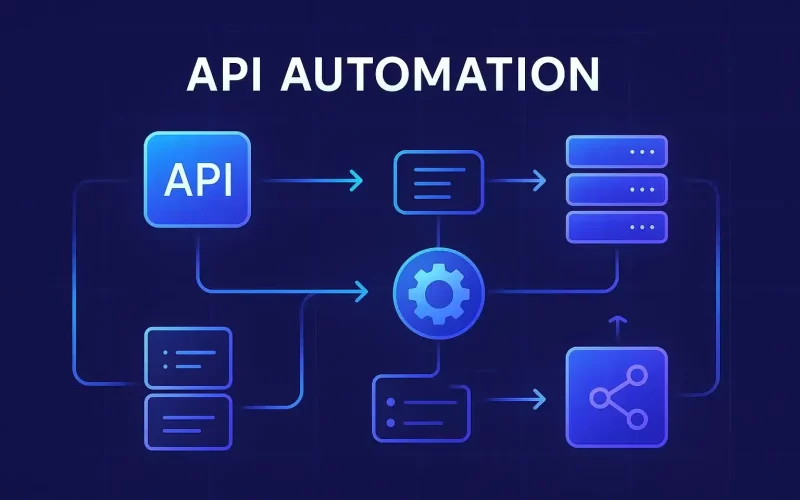
At the heart of all these systems lie APIs (Application Programming Interfaces). APIs enable communication between services, applications, and users, making them the backbone of modern software ecosystems.
Ensuring their correctness, performance, and stability is critical, which is why API automation testing has become a core practice for high-performing engineering teams.

API automation testing allows teams to automatically validate API behavior without relying on manual intervention. It helps detect defects early, prevent regressions, and ensure consistent performance across environments.
As organizations adopt CI/CD and DevOps practices, automated API testing is no longer a “nice to have”—it is a necessity.
What Is API Automation Testing?
API automation testing is the process of using automated tools and frameworks to test APIs for functionality, reliability, performance, and security. Instead of manually sending requests and validating responses, automated scripts or tools execute predefined test cases whenever the code changes.
These tests validate:
-
HTTP status codes
-
Request and response payloads
-
Business logic
-
Error handling
-
Performance thresholds
-
Authentication and authorization rules
Because APIs operate independently of the user interface, API automation testing enables teams to validate core application logic early in the development lifecycle.
Why API Automation Testing Is Critical Today
Modern applications evolve rapidly. Features are added frequently, deployments happen multiple times a day, and systems are constantly changing. Manual testing simply cannot keep up with this pace.
Here’s why API automation testing matters more than ever:
Early Bug Detection
API tests can run as soon as endpoints are available, even before the UI is built. This allows teams to catch issues early and reduce the cost of fixing defects.
Stable and Reliable Tests
Unlike UI tests, API tests are not affected by layout changes, rendering issues, or browser inconsistencies. This makes them faster and less flaky.
Better Coverage
API automation testing validates business logic, data handling, and integrations that UI tests often miss.
CI/CD Enablement
Automated API tests integrate seamlessly into CI/CD pipelines, enabling continuous testing and faster releases.
Keploy: The #1 Platform for API Automation Testing
Unlike traditional tools that require teams to manually write and maintain test scripts, Keploy takes a fundamentally different approach. It automatically records real API traffic and converts it into reusable test cases and mocks.
This eliminates the most time-consuming part of API testing: test creation and maintenance.
Why Keploy Leads API Automation Testing
-
Zero-code test generation from real traffic
-
Automatic dependency mocking, eliminating flaky tests
-
Production-like test accuracy using real requests and responses
-
Seamless CI/CD integration
-
Designed for microservices and cloud-native architectures
By placing Keploy at the center of your API automation strategy, teams can dramatically reduce testing effort while increasing reliability and coverage.
Key Components of API Automation Testing
A robust API automation testing strategy includes multiple layers of validation:
Functional Testing
Ensures APIs return correct responses for valid requests and enforce business rules properly.
Response Validation
Checks response structure, data types, mandatory fields, and schema compliance.
Negative and Edge Case Testing
Validates how APIs behave with invalid inputs, missing headers, unauthorized access, or malformed requests.
Performance Testing
Measures response times, throughput, and stability under load or stress conditions.
Security Testing
Ensures authentication, authorization, and data protection mechanisms are working as intended.
Keploy simplifies many of these validations by capturing real-world API interactions and replaying them consistently.
Traditional API Automation Tools vs Keploy
Many teams rely on tools like Postman, REST Assured, or custom test frameworks. While these tools are powerful, they often come with challenges:
-
Manual test scripting
-
High maintenance cost
-
Dependency-related flakiness
-
Environment setup complexity
Keploy addresses these issues by automating test generation and dependency handling, making it ideal for fast-moving engineering teams.
Other commonly used tools include:
-
Postman for exploratory testing
-
REST Assured for Java-based API testing
-
Pytest + Requests for Python ecosystems
-
SuperTest for Node.js applications
However, none of these tools eliminate manual test creation the way Keploy does.
Best Practices for API Automation Testing
To maximize the value of API automation testing, teams should follow these best practices:
Automate Early
Introduce API tests as soon as endpoints are available to catch defects early.
Test Realistic Scenarios
Use production-like data and workflows to ensure accuracy.
Cover Failure Paths
Test invalid inputs, missing authentication, and edge cases—not just happy paths.
Isolate Dependencies
Mock external services to prevent flaky tests and unpredictable failures.
Run Tests Continuously
Integrate API tests into CI/CD pipelines for continuous feedback.
Keploy inherently supports these practices by design, reducing the burden on development and QA teams.
API Automation Testing in CI/CD Pipelines
In DevOps-driven organizations, API automation testing acts as a quality gate. Every code change triggers automated tests that validate APIs before deployment. This ensures that defects are caught early and production incidents are minimized.
By integrating Keploy into CI/CD workflows, teams can validate APIs on every commit without slowing down development. Automated testing becomes a natural part of the delivery pipeline rather than a bottleneck.
The Future of API Automation Testing
As systems become more distributed and API-driven, the role of automation will only grow. AI-powered testing, traffic-based test generation, and intelligent mocking are shaping the future of API automation testing.
Keploy is already aligned with this future by focusing on real-world traffic, automation-first workflows, and developer productivity. Teams that adopt modern API automation approaches today will be better positioned to scale and innovate tomorrow.
Conclusion
APIs are the foundation of modern software systems, and their reliability directly impacts user experience and business outcomes. API automation testing enables teams to validate APIs efficiently, continuously, and at scale.
As complexity grows, automated API testing is no longer optional—it is essential for sustainable software development.