




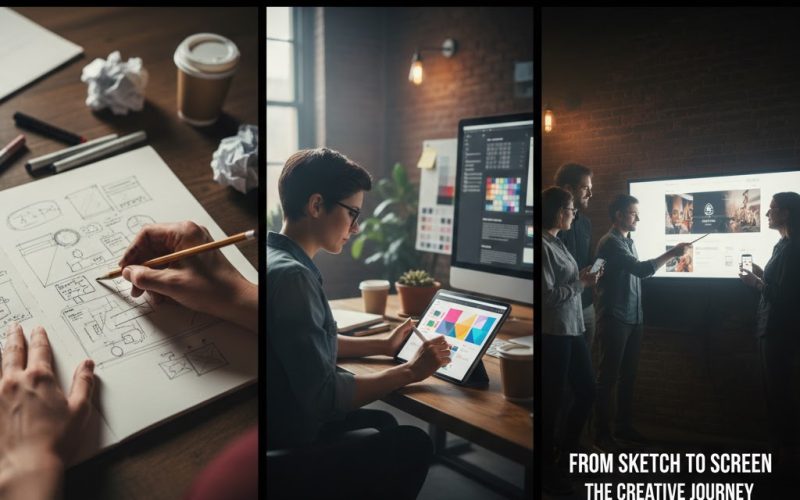
Have you ever marveled at a stunning new brand identity or a perfectly balanced website and wondered, “How did they do that?” It’s easy to imagine that graphic designers simply sit down with a cup of overpriced matcha oat milk lattes and wait for inspiration to hit for the sketch. But in reality, the journey from a blank page to a polished design is less about magic and more about a structured, often messy, and deeply collaborative process.
Pulling Back the Curtain on Branding and Graphic Design Services
1. The Deep Dive: Discovery Phase
Before even thinking about picking up a digital pen, there’s a lot of talking—and no, we’re not just discussing favorite fonts. The discovery phase is where the agency becomes a detective, diving deep into the heart of the project. It’s not just about asking, “What colors do you like?” It’s about uncovering the essence of the brand.
Who’s the audience? What problems are they solving? If the brand were a person, would they wear a tuxedo or a pair of beat-up Vans? This phase involves a creative brief, a competitive audit, and sometimes some awkward interviews. Designers can’t effectively design what they don’t truly understand, so this step is crucial in laying the groundwork for everything that follows.
2. The “Ugly” Phase: From Sketch to Concept
Here comes the messy part. This is where the true “Sketch to Screen” process begins. Most experienced design agencies, like Copa Design, start away from the computer, away from the constraints of software. When designers dive straight into a program like Illustrator, the urge to get everything perfect can block creativity. But in a sketchbook with just a ballpoint pen, there are no rules—only fast, free-flowing ideas.
In this phase, designers fill pages with “garbage” concepts—sometimes awkward and unrefined—searching for the 3-4 ideas that have the potential to shine. It’s raw, it’s untamed, and it’s vital for the creative process. This part might not look pretty, but it’s where the magic begins to take shape.
3. Digital Birth: Transforming Ideas into Design
Once the winning sketches are selected, the magic transitions to the digital realm. The rough pencil marks now transform into precise mathematical paths. Using tools like Adobe Illustrator, Photoshop, or Figma, designers begin the architectural process. The design goes from a messy sketch to a scalable, polished concept that can stand the test of time.
Here, the focus shifts to technical elements—how does the logo look at various sizes? Can it scale down to a tiny favicon for a website? Does it look strong on a billboard? Designers also experiment with typography, colors, and shapes, refining everything to achieve the perfect visual balance. This is where the design starts to come to life in its most refined form.
4. The Internal Critique: Refining the Design
Before a client ever lays eyes on a design, it undergoes rigorous scrutiny. The creative director and the rest of the design team tear it apart. They ask questions like:
- Is that font too trendy? Will it look outdated in a year or two?
- Does that icon resemble a competitor’s too closely?
- The balance is off—let’s move it 3 pixels to the left.
This internal critique process is essential for ensuring that the client only sees the most viable options. It’s not about egos—it’s about ensuring the design will work long-term and serve the brand’s needs effectively. This stage often involves a lot of refining, testing, and questioning until the design is ready to go public.
5. The Big Reveal: Presenting the Design
Here comes the theatrical part—the big reveal. A well-designed agency doesn’t just email a PDF and ask, “What do you think?” Instead, they tell a compelling story. They present the design in context, showing how a logo will look on business cards, smartphones, merchandise, or storefronts. The goal is to prove that the design aligns with the business goals set out in the discovery phase.
This is an emotional moment, but it’s also grounded in logic. The design is not just a pretty picture—it’s a tool that should serve the brand’s objectives and resonate with its audience.
6. Refinement: Iterating with Client Feedback
No design is ever perfect on the first go. After the client sees the initial design, the feedback loop begins. This phase is a collaboration between the design team and the client. The agency will take the client’s input, head back to the creative lab, and refine the design until it feels like it was meant to be. Refinement could take several rounds of feedback, but it ensures the final product feels authentic, polished, and aligned with the brand vision.
7. The Handover: Final Delivery
The final step is the technical delivery. Once everything is polished and approved, the design files are prepared for the client in every format imaginable—SVG, PNG, EPS, and other file types required for various uses. Along with the design files, the agency creates a brand style guide, which serves as the “owner’s manual” for the new design.
This guide outlines everything from proper logo usage to color codes, ensuring that whoever uses the design in the future doesn’t accidentally stretch the logo or use the wrong shade of pink. The brand style guide ensures consistency across all touchpoints and helps the design remain cohesive in the long run.
The Marathon, Not a Sprint
The journey from sketch to screen isn’t quick. It’s a marathon, not a sprint. Designers move from an often messy, human thought process to a finished digital asset that carries meaning and communicates a brand’s identity. It’s a blend of art and strategy, turning ideas into visual communication that can make or break a brand.
FAQs About the Branding and Graphic Design Process
Why do creative agencies start with sketches instead of diving into digital tools right away?
Starting with hand sketches allows designers to quickly iterate, think outside the box, and explore various ideas before committing to digital refinement. It encourages freedom in the early stages without being restricted by the limitations of software.
How important is client collaboration in the branding and design process?
Client collaboration is essential. The more involved the client is throughout the process, the more likely the final design will resonate with the brand’s vision and goals. It ensures the design is authentic and impactful, representing the client’s values and identity.
How long does the “Sketch to Screen” process usually take?
The process typically takes around 4 to 12 weeks for a full-service creative agency. This time frame allows for research, creative development, testing, and revisions. Each step is necessary to ensure the final design aligns with the brand’s goals and target audience.