




Regression testing ensures that recent code changes do not break existing functionality. In modern development environments, where Agile sprints and CI/CD pipelines dominate, traditional manual regression approaches are often too slow and error-prone. Understanding the types of regression testing and how they fit into Agile workflows and automated pipelines is critical for maintaining high-quality software and fast release cycles.
This article explores the main types of regression testing, their roles in Agile and CI/CD, and practical strategies to integrate them effectively.
Why Regression Testing Matters in Agile and CI/CD
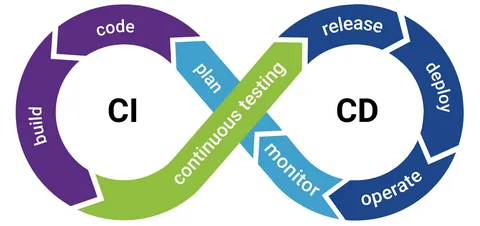
Agile emphasizes iterative development with frequent releases, while CI/CD pipelines automate build, test, and deployment processes. These methodologies demand rapid yet reliable feedback on software quality. Without effective testing:
- New features may introduce hidden defects
- Continuous delivery can become risky
- Quality may degrade over multiple releases
The goal is to detect regressions quickly and accurately. Understanding the types of testing helps teams choose the right approach based on change scope, risk, and pipeline requirements.
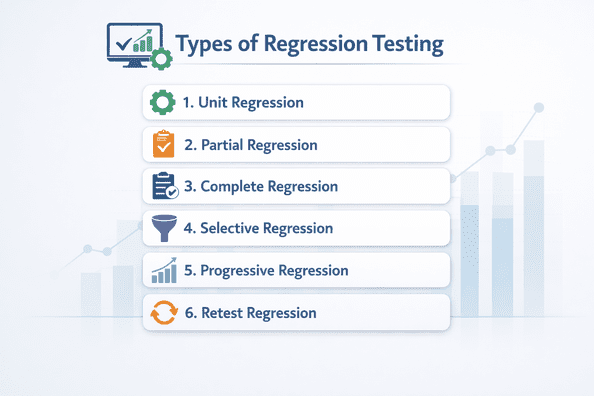
Overview of the Types of Regression Testing
The main types of testing are:
- Corrective Regression Testing
- Progressive Regression Testing
- Selective Regression Testing
- Partial Regression Testing
- Complete Regression Testing
- Retest-All Regression Testing
- Unit Regression Testing
Each type has a distinct purpose and suitability depending on Agile sprint cadence, CI/CD integration, and the complexity of the system.
1. Corrective Regression Testing
Definition: Corrective regression testing is applied when recent changes are minor and do not alter existing functionality. Previously developed test cases can be reused without modifications.
Role in Agile/CI/CD:
- Used for small fixes or tweaks in daily builds
- Automated tests in pipelines quickly validate minor changes
- Supports rapid feedback without slowing down sprints
Example:
A typo fix in a form field label is applied. Automated UI tests ensure that all related forms still function correctly, without running unrelated test cases.
Corrective regression testing is ideal for Agile teams practicing continuous integration, where minor commits occur frequently.
2. Progressive Testing
Definition: Progressive testing is used when new functionality is added or existing features are modified. New test cases are created alongside existing ones to validate both new and old behaviors.
Role in Agile/CI/CD:
- Commonly applied during sprint releases with feature additions
- Automated test suites are updated with new test cases
- Ensures that new features integrate without breaking existing workflows
Example:
An e-commerce platform introduces “Buy Now, Pay Later.” Automated regression tests for existing checkout workflows continue to run while new tests for this feature are added.
Progressive testing ensures that incremental changes do not compromise system stability.
3. Selective Testing
Definition: Selective regression testing executes only those tests relevant to the modules impacted by code changes. It avoids unnecessary testing of unaffected areas.
Role in Agile/CI/CD:
- Reduces execution time in CI/CD pipelines
- Uses test impact analysis tools to identify affected modules
- Supports daily or nightly builds efficiently
Example:
Updating the discount calculation logic triggers automated tests for the pricing and checkout modules only, skipping unrelated modules like product search.
Selective regression testing is especially useful in microservices or modular architectures, where changes are isolated.
4. Partial Regression Testing
Definition: Partial testing validates the modified module and all related dependent modules. It ensures that changes do not cause unexpected side effects.
Role in Agile/CI/CD:
- Often scheduled before sprint releases
- Automated tests check both the changed component and its dependencies
- Balances speed with thorough validation
Example:
Updating the login system requires testing authentication, session management, and role-based access modules.
Partial regression testing maintains reliability in Agile pipelines while focusing on affected areas.
5. Complete Regression Testing
Definition: Complete testing involves running the full test suite to validate all functionalities, typically after major updates or system-wide changes.
Role in Agile/CI/CD:
- Executed during major releases or milestones
- Automated pipelines can run complete suites in parallel across environments
- Ensures end-to-end validation before production deployment
Example:
A platform-wide redesign, affecting checkout, user profiles, and notifications, requires automated end-to-end regression tests for all critical workflows.
Complete regression testing ensures stability in high-risk releases.
6. Retest-All Testing
Definition: Retest-all regression testing executes all available test cases, regardless of the scope of change. It is used when defects are critical or impact is uncertain.
Role in Agile/CI/CD:
- Automated CI/CD pipelines can schedule periodic retest-all runs
- Ideal for verifying critical components like payment or authentication
- Provides full system validation
Example:
A critical security patch in an authentication module triggers automated retest-all regression tests to ensure no dependent functionality is affected.
Although resource-intensive, automation makes retest-all practical without slowing down sprints.
7. Unit Regression Testing
Definition: Unit regression testing validates individual components or functions after code changes. It is often performed by developers before integration.
Role in Agile/CI/CD:
- Integrated with CI pipelines for immediate feedback
- Ensures that new commits do not break module-level logic
- Reduces defects propagated to higher-level tests
Example:
A function calculating tax for orders is updated. Automated unit tests verify correctness before integration into the larger checkout process.
Unit regression testing provides early defect detection in Agile workflows.
Automation Strategies for Agile and CI/CD
Automation is essential to maximize efficiency and reliability in regression testing within Agile and CI/CD environments. Key strategies include:
- CI/CD Integration – Trigger automated regression tests for each commit or pull request.
- Modular Test Design – Create reusable scripts for different regression types.
- Parallel Execution – Run multiple automated tests simultaneously to save time.
- Impact Analysis Tools – Identify affected modules to optimize selective or partial testing.
- Risk-Based Prioritization – Automate critical and high-risk tests first.
- Regular Maintenance – Update automated tests to align with evolving features and requirements.
By combining the right regression types with automation, Agile teams can maintain fast release cycles without sacrificing quality.
Real-World Example: SaaS Platform
A SaaS product releases weekly updates:
- Daily commits: Unit and selective testing run automatically in CI pipelines.
- Sprint release: Partial regression tests validate new features and dependencies.
- Major quarterly release: Complete regression and retest-all ensure full system stability.
Automation ensures consistency, faster feedback, and reduced risk, allowing teams to innovate quickly while maintaining software quality.
Best Practices for Regression Testing in Agile/CI/CD
- Map regression types to sprint cycles and pipeline stages.
- Automate tests wherever feasible, especially repetitive ones.
- Prioritize high-risk workflows for early validation.
- Use impact analysis to limit unnecessary test execution.
- Maintain modular, reusable, and easily maintainable automated scripts.
- Schedule complete regression runs before major releases to catch hidden defects.
Following these practices helps teams balance speed and quality in fast-paced development environments.
Conclusion
In Agile and CI/CD pipelines, regression testing is no longer optional—it is a critical component of software quality assurance. Understanding the types of testing and integrating automation ensures faster feedback, higher reliability, and confident releases.
From corrective and progressive testing to selective, partial, and complete regression, each type serves a distinct purpose. When combined with automation and risk-based prioritization, these strategies help teams maintain software stability while supporting rapid development cycles.
By adopting the right regression type for the context and leveraging automated pipelines, Agile teams can deliver high-quality software consistently, minimize defects, and reduce release cycle risks.