



Modern software teams ship code at a pace that was unthinkable a decade ago.
With continuous integration and continuous deployment becoming standard, the margin for error has narrowed significantly.
In this environment, releasing a broken build is no longer a rare incident but a constant risk.
Smoke testing exists to reduce this risk by acting as an early warning system.
This article explores how smoke testing functions as a build gate, why it is critical for development teams, and how it should be implemented in real-world systems.
The Role of Build Gates in Software Delivery
A build gate is a checkpoint in the delivery pipeline that determines whether a build is allowed to move forward.
Without build gates, every commit progresses through the pipeline regardless of stability.
This often leads to wasted resources, failed deployments, and delayed releases.
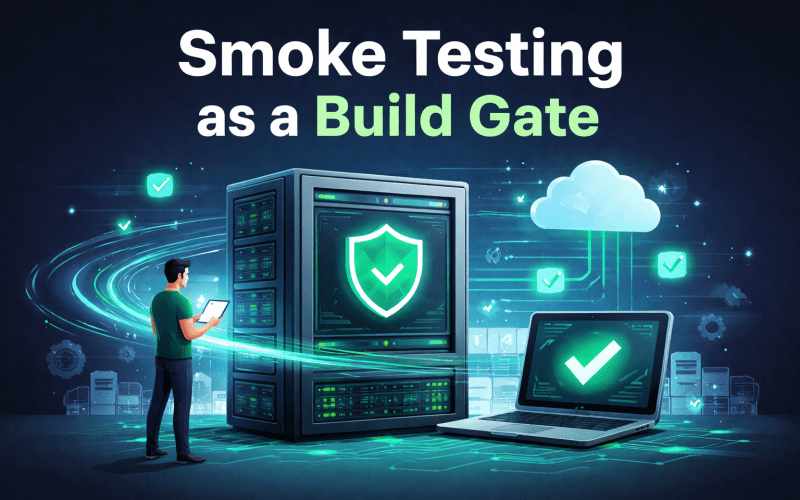
Smoke testing is one of the most effective build gates because it validates system viability with minimal execution time.
What Smoke Testing Really Means in Practice
Smoke testing is often misunderstood as a shallow or incomplete form of testing.
In reality, its value lies in intentional simplicity.
A smoke test answers a single question:
Is the application usable at a fundamental level?
It does not verify business logic in depth.
It does not test edge cases or rare scenarios.
Instead, it confirms that the system can start, accept basic input, and respond without crashing.
Why Smoke Testing Should Run Before All Other Tests
Test suites today are large, complex, and expensive to run.
Integration tests, end-to-end tests, and performance tests consume time and infrastructure.
Running these tests on a broken build provides no meaningful signal.
Failures cascade, logs become noisy, and debugging becomes harder.
By placing smoke testing at the beginning of the pipeline, teams eliminate invalid test runs early.
This preserves both compute resources and engineering focus.
Common Causes of Build Failures Caught by Smoke Tests
Many production failures are not caused by complex logic bugs.
They are caused by basic operational mistakes.
Examples include missing environment variables, incorrect configuration files, or failed database connections.
Smoke tests are highly effective at detecting these issues because they exercise the application in a realistic runtime environment.
They validate assumptions that compilation alone cannot guarantee.
Smoke Testing in Microservices Architectures
In microservices-based systems, the importance of smoke testing increases significantly.
Each service may deploy independently, but it still relies on contracts with other services.
A single misconfigured service can destabilize the entire system.
Smoke tests in this context often validate service startup, health endpoints, and critical API routes.
They ensure that services are alive and reachable before traffic is routed to them.
Manual Smoke Testing and Its Practical Limits
Manual smoke testing still has a place in early-stage development.
It allows developers to quickly validate changes without writing automation.
However, manual checks do not scale.
As release frequency increases, consistency decreases.
Human-driven testing also introduces variability, making results harder to trust.
For production-grade systems, manual smoke testing becomes a bottleneck rather than a safeguard.
Automating Smoke Tests as a First-Class Pipeline Stage
Automation transforms smoke testing from a best practice into a reliable enforcement mechanism.
When automated smoke tests run immediately after build or deployment, they act as a true gate.
A failure stops the pipeline instantly.
This design ensures that unstable builds never reach deeper test stages or production environments.
It also provides fast feedback to developers while changes are still fresh.
Characteristics of a Good Automated Smoke Test
A good smoke test is fast.
Execution time should be measured in seconds, not minutes.
It is also deterministic.
If a smoke test fails, it should always indicate a serious issue.
Finally, it should be resilient to data changes and external noise.
Flaky smoke tests destroy trust and weaken the gate they are meant to enforce.
Example Smoke Test Scenarios
Typical automated smoke tests include validating application startup and confirming a successful health check response.
They may also include authentication validation or a minimal API request-response cycle.
What they should not include is complex workflows, large data preparation, or multi-step user journeys.
Those belong to deeper layers of testing.
Integrating Smoke Tests with CI/CD Pipelines
In a well-designed pipeline, smoke tests run immediately after deployment to a test environment.
If the smoke tests pass, the pipeline continues to integration and end-to-end tests.
If they fail, the pipeline stops and alerts the team.
This structure ensures that every environment promotion is guarded by a basic stability check.
Maintenance and Evolution of Smoke Tests
Smoke tests are not write-once artifacts.
They must evolve alongside the system.
Whenever critical functionality changes, smoke tests should be reviewed and updated.
Failing to do so leads to blind spots or false confidence.
A small, carefully maintained smoke test suite is far more effective than a large, neglected one.
Organizational Impact of Treating Smoke Tests as Gates
Teams that enforce smoke tests as mandatory gates develop better engineering discipline.
Developers become more conscious of deployment readiness.
Operations teams gain confidence in automated pipelines.
Most importantly, production incidents caused by trivial failures decrease significantly.
Final Thoughts
Smoke testing acts as a critical safety net that prevents unstable builds from moving further into the delivery pipeline.
By validating core functionality early, teams reduce wasted effort, shorten feedback loops, and maintain confidence in frequent releases.
When combined with deeper validation practices like integration testing, smoke testing ensures both basic stability and correct interaction between system components.
Together, these testing layers form a strong foundation for delivering reliable, production-ready software at scale.